Category: Asia Gaming

  • Why Southeast Asia Became One of Gaming’s Most Passionate Competitive Markets

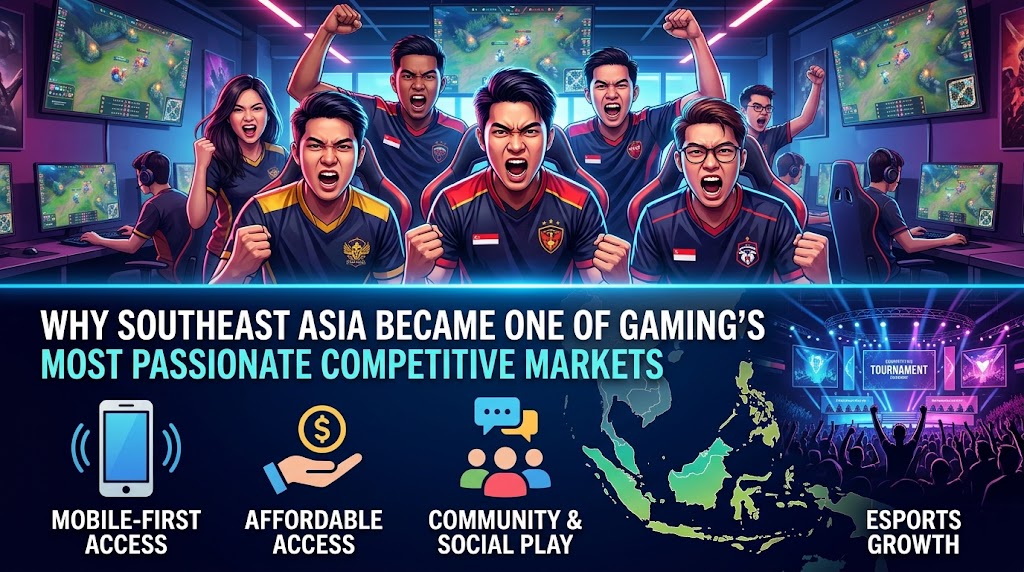
    Why Southeast Asia Became One of Gaming’s Most Passionate Competitive Markets

    Southeast Asia gets talked about as a gaming region mostly in terms of numbers — huge player counts, massive mobile download figures, that kind of thing. The numbers are real, but they’re not really the interesting part. What actually separates this region is the culture wrapped around the games, the way competition here grew out of community first and scale second. A lot of markets got big. Fewer got this attached to the process.

    A Region Built Around Gaming Communities

    Internet cafés did a lot of the early groundwork, the same way they did across most of Asia, but the flavor here was distinct. These weren’t just places to play — they were social hubs where showing up mattered as much as the game itself. You went because your friends were going, and the match was almost secondary to the hangout.

    Local communities formed around specific cafés and specific games the way neighborhoods form around a coffee shop. Gaming groups grew out of that repetition — the same faces, the same rivalries, week after week.

    Social gaming was baked into the culture from the start in a way that’s easy to underestimate if you’re comparing it to markets where gaming stayed a more solitary hobby for longer. Here, gaming was rarely something you did alone.

    The Impact of Affordable Internet and Smartphones

    Everything shifted once smartphones got cheap and internet got affordable, and it happened faster in Southeast Asia than in a lot of other regions with comparable income levels. Mobile-first audiences emerged almost by default rather than by trend — plenty of players in the region got online through a phone before they ever touched a home PC.

    Accessibility is really the whole story here. A smartphone costs a fraction of a gaming PC and does a hundred other useful things besides play games, which makes it a far easier purchase to justify for most households.

    Online multiplayer on mobile removed the last real barrier, letting players compete against people in neighboring cities or neighboring countries without needing anything beyond a phone and a data plan. That combination — cheap hardware, cheap data, immediate multiplayer access — is a big part of why adoption moved as fast as it did.

    Why Mobile Gaming Became Particularly Important

    Smartphone penetration in the region climbed quickly enough that mobile stopped being a secondary platform and became the primary one for a huge share of players, which isn’t true everywhere mobile gaming is popular. In plenty of Western markets, mobile is still treated as the casual tier below “real” PC or console gaming. That framing never really took hold here.

    Lower hardware barriers meant the region didn’t have to wait for gaming PCs or consoles to become affordable before a competitive scene could exist. Games like Mobile Legends and PUBG Mobile built entire professional ecosystems on phones, not as a workaround, but as the actual foundation.

    Social play tied back into that community-first culture from the start — mobile games built around squads and guilds fit naturally into a gaming culture that had always treated playing together as the default rather than the exception.

    Local Gaming Communities and Competition

    Amateur tournaments kept multiplying as smartphone access spread, often organized by the same kind of committed local players who ran early internet café events, just with a much bigger potential audience to draw from thanks to online signups and mobile accessibility.

    Campus competitions became a specific and important pipeline in several countries in the region. University gaming clubs turned into genuine talent pools, with student tournaments occasionally producing players who went on to compete professionally within a few years of graduating.

    Community events, whether tied to a mall activation, a mobile carrier promotion, or a local esports organization just trying to build a following, kept the grassroots layer alive even as the professional side of the scene grew increasingly separate and structured above it.

    The Growth of Professional Esports

    Teams started forming out of the strongest amateur and campus rosters once it became clear that regional tournaments actually had money behind them worth competing for seriously.

    What used to be a group of friends grinding ranked matches together turned into an organization with sponsors, branding, and actual expectations attached.

    Regional tournaments grew alongside this, offering prize pools large enough to make competing a genuinely viable path rather than just a hobby with occasional payouts.

    Professional players emerged from this pipeline in growing numbers, and for many of them, mobile esports specifically offered a route to a competitive career that PC or console gaming never could have, simply because the entry cost was so much lower to begin with.

    Southeast Asia as a Regional Esports Ecosystem

    Indonesia has one of the largest player bases in the region by sheer population, and its Mobile Legends scene in particular has produced some of the most passionate fanbases anywhere in competitive gaming, full stop.

    The Philippines built a similarly intense following, with Mobile Legends and Dota 2 both carrying serious cultural weight — Filipino teams have a long, well-earned reputation in Dota specifically, going back years before the current mobile boom even started.

    Thailand’s scene leans strong across both mobile and PC titles, with a level of local broadcast and sponsorship support that’s fairly mature compared to some of its neighbors.

    Malaysia sits in a similar position, with a competitive scene that benefits from decent infrastructure and a player base engaged across multiple genres rather than concentrated in just one or two dominant titles.

    Singapore, despite a much smaller population than its neighbors, punches above its weight thanks to strong internet infrastructure and its role as something of a regional hub for tournament organizers and event logistics.

    Vietnam has built a genuinely serious PC gaming culture alongside its mobile scene, with League of Legends and other PC titles maintaining a strong following that hasn’t been fully displaced by the mobile wave the way it has in some neighboring markets.

    What Makes the Region Different

    Diverse cultures across these countries mean the region never developed as one uniform gaming market, and that’s arguably a strength rather than a limitation. What works in Indonesia doesn’t automatically translate to Vietnam, and organizers who’ve tried to treat Southeast Asia as a single market have generally learned that lesson the hard way.

    Different markets within the region operate on different timelines and different platform preferences, from Vietnam’s stronger PC culture to the heavily mobile-dominated scenes elsewhere.

    Strong community engagement runs through all of them regardless of those differences, though. Whatever the platform or the country, the underlying culture of treating competitive gaming as something worth showing up for in person, cheering loudly for, and building an identity around tends to hold steady across the whole region.

    Where Southeast Asian Competitive Gaming Could Go Next

    Mobile isn’t slowing down, and if the region’s history is any indication, whatever comes after current mobile titles will probably find fertile ground here faster than in markets more tied to PC and console infrastructure.

    Cross-border competition is likely to keep deepening too, building on regional tournaments that already bring Indonesian, Filipino, Thai, and Vietnamese teams into direct contact more often than they used to compete.

    Professional infrastructure is probably the area with the most room left to grow. Training facilities, coaching staff, and long-term player development systems are still uneven across the region — strong in some countries, still fairly informal in others.

    Closing that gap is likely the next real milestone, not because the talent or the passion is missing, but because the structural support around it hasn’t fully caught up to how much the region has already proven it can produce.

  • How Competitive Gaming in Asia Grew From Local Tournaments Into a Global Force

    How Competitive Gaming in Asia Grew From Local Tournaments Into a Global Force

    Ask someone who’s been around Asian esports since the early days how it started, and you’ll get a story about a specific cafe, not a movement. A room with decent PCs, a few regulars who kept showing up, someone eventually taping a bracket to the wall because enough people wanted to know who was actually good.

    That’s it. No sponsor, no broadcast deal, nobody thinking they were building anything. Just a rivalry that needed settling.

    South Korea’s the example everyone reaches for, and honestly it deserves it. PC bangs took off in the late 90s mostly because home internet was garbage almost everywhere at the time, and StarCraft turned into something closer to a national obsession than a hobby. I don’t think anyone planned that.

    Cheap, fast connections happened to exist in one specific place at one specific moment, and StarCraft happened to be the game everyone was playing when it did. Korea produced some of the first professional gamers on the planet mostly because of that accident — the game and the infrastructure lined up years before most of the world had either.

    The Early Days of Competitive Gaming in Asia

    LAN cafes solved two problems nobody was trying to solve on purpose. Cheap access to hardware players couldn’t buy themselves, and a room where you sat next to the person you were trying to beat.

    That second part gets underrated. Trash talk, rematches on the spot, glancing at someone’s screen mid-game — you learn faster sitting three feet from a rival than you do grinding solo at home, and everyone who was there will tell you the same thing.

    Communities built up around specific shops and specific games. Ask around Jakarta from that era, and someone will mention “the DOTA place” like it’s a landmark, because it kind of was.

    Tournament formats back then were held together with duct tape, basically. Entry fees pooled into a prize, a bracket stuck to a wall, maybe the cafe owner threw in something extra because a packed house on a Saturday was good for business either way.

    Nobody was building an industry. People just wanted bragging rights over the guy who picked the same character every single match.

    How Local Communities Created Competitive Scenes

    Teams didn’t form because someone drew up a plan. A few players kept ending up on the same side, or kept losing to the same rival duo, and eventually started practicing on purpose instead of by accident.

    That’s more or less the origin story for team culture across the region — Counter-Strike squads in the Philippines, early DOTA rosters in China, doesn’t matter where you look, it rhymes.

    The organizers were rarely businesspeople. Usually just the player who cared enough to actually run something. A flyer taped up at the cafe. A forum post. If you were lucky, a mention on local radio because the organizer’s cousin worked there.

    There was no ticketing, no stream, no way to watch unless you physically showed up. Which meant the audience and the competitors were often the same twenty people, just wearing different hats depending on the day.

    The Rise of Regional Tournaments

    City scenes started feeding national ones, and national scenes started eyeing each other across borders — though not on any kind of shared timeline.

    Korea’s StarCraft scene professionalized way ahead of most of Southeast Asia’s gaming market, partly because Korean broadcast TV picked up esports early. OGN was running dedicated matches on television when that idea would’ve sounded absurd almost anywhere else.

    Going cross-border introduced headaches local tournaments never had to deal with. Travel budgets. Visas. Arguments over whose house rules applied when two regions had drifted slightly on the same game.

    Prize pools grew, but slower than people like to remember — some early regional events paid out less than what it cost players to get there in the first place.

    Sponsorship eventually fixed that math, though unevenly. Some countries had telecoms and hardware brands willing to write checks years before their neighbors did.

    Internet Infrastructure Changed the Scale of Competition

    None of the regional stuff works without the internet actually catching up, and it’s easy to forget how recently that happened. Broadband rollout across East and Southeast Asia through the 2000s and into the 2010s meant you didn’t need a cafe anymore to play at a decent level — though a lot of people kept going anyway, because home connections in plenty of places still couldn’t touch what a cafe offered.

    Latency was brutal in ways that get glossed over now. A player in Manila queuing against someone in Seoul on early matchmaking wasn’t just playing the opponent; they were fighting the ping too.

    Server placement made this worse — publishers defaulted to North America and Europe for years, which left chunks of Asia with connection quality that didn’t match how many players were actually there. Regional servers eventually caught up, and once they did, online cross-border competition stopped being a novelty and started being normal.

    The Professionalization of Asian Esports

    Somewhere in between “team that scrims together” and “team on a payroll,” things shifted. Coaches started breaking down replays the way a football coach breaks down game film.

    Analysts tracked opponent tendencies instead of just vibing off memory. Sponsors moved on from the local phone shop to telecoms and energy drink brands with actual marketing departments behind them.

    Leagues locked this in. A season structure meant players could plan a career around competing instead of treating it as something you did between real jobs.

    Streaming did the rest. Once anyone with a connection could watch a match instead of only the twenty people in the room, sponsors finally had numbers they could point to — viewers, engagement, something resembling a return.

    Why Asia Became Central to Competitive Gaming

    Population helps, sure, but that’s the lazy explanation. Plenty of regions have big populations and never built anything close to this. What’s different is that gaming as a legitimate pursuit got accepted earlier and more openly in several Asian countries, while “professional gamer” was still a punchline at a lot of Western dinner tables well into the 2010s.

    Mobile mattered enormously in Southeast Asia specifically, and I’d argue more than people give it credit for. A gaming PC is expensive. A phone is something most people already own. Mobile Legends and PUBG Mobile built massive competitive scenes in the Philippines, Indonesia, and Vietnam largely because the barrier to entry was a device people already had in their pocket.

    Stack that on top of steadily improving internet and years of accumulated cafe-culture know-how, and you get a region that didn’t need to import competitive gaming from anywhere. It grew on its own and kept compounding.

    From Local Tournaments to a Global Audience

    Streaming did something local tournaments never could — it made a Manila crowd’s tournament watchable in São Paulo without anyone leaving their couch. Fifteen years ago, watching a foreign region meant hunting down a grainy upload weeks after the fact, assuming one existed at all.

    International events made the shift concrete. When Asian teams started actually winning — The International, League of Legends Worlds, Counter-Strike majors — it did two things at once.

    It proved the regional talent could hang with anyone on earth, and it forced Western audiences to stop treating Asian leagues as some separate, lesser tier worth a passing glance at best.

    What Comes Next for Competitive Gaming in Asia

    Mobile esports isn’t just keeping pace anymore; it’s arguably setting it, which is a real reversal from a decade ago when PC and console led, and mobile followed.

    Cross-platform play is muddying lines that used to be clean, and leagues are still arguing over fairness and matchmaking in ways that don’t have tidy answers yet.

    Cloud gaming could, in theory, remove hardware as a barrier entirely. In practice, the infrastructure to make that work well is still patchy across parts of the region, so I wouldn’t bet on it happening evenly or soon.

    New players keep arriving through mobile titles that ask for almost nothing upfront, which is probably the more reliable growth story here than cloud gaming for the next few years at least.

    None of this happened because of one tournament or one breakout star, whatever the highlight reels want you to believe. It came from cafes that gave players somewhere to compete, rivalries that hardened into teams, infrastructure that kept expanding what was actually possible online, and a slow professionalization process that turned casual competition into something people could build a career on.

    That’s a long, uneven history — and it’s why Asia isn’t just showing up to global esports anymore. Most of the time, it’s the one setting the pace.