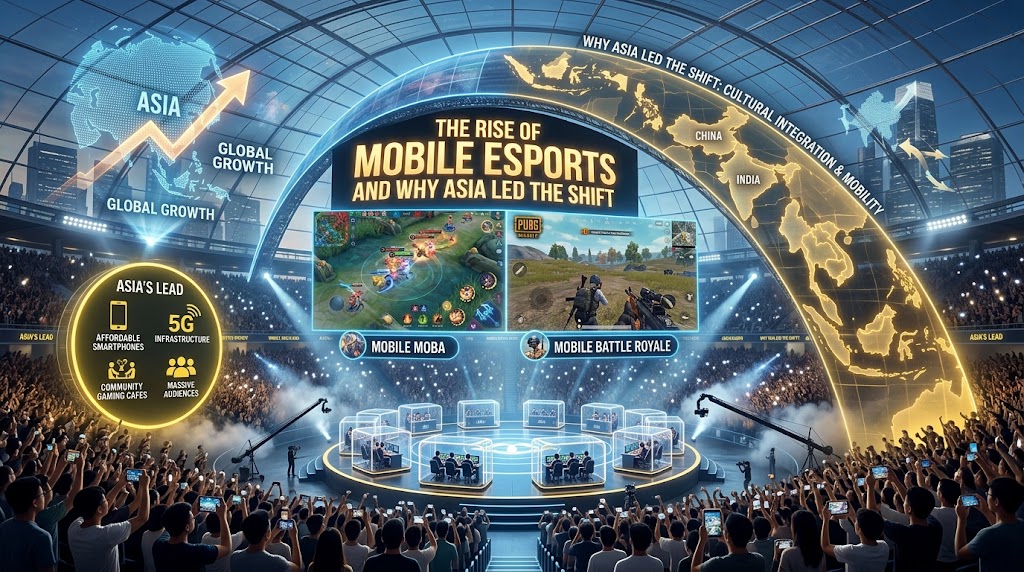
There’s still a certain kind of gamer who hears “mobile esports” and pictures someone tapping a screen between subway stops, not a professional athlete.
Fair reaction a decade ago. Not anymore. In several of the biggest gaming markets on the planet, mobile isn’t the casual tier underneath “real” competitive gaming. It’s the main event, and it got there faster than most people watching from the PC side ever expected.
Why Mobile Changed Gaming Accessibility
Smartphones being everywhere isn’t really the interesting part — phones were going to be everywhere regardless, since people needed them for calls and messaging long before anyone cared whether they could run a competitive shooter.
Gaming just got to ride along on infrastructure built for entirely different reasons.
Cost is where this actually bites. A decent gaming PC is real money. A console isn’t far behind once you add games and a controller or two. A phone that runs competitive mobile titles well costs a fraction of either, and for a lot of players, the choice was never mobile versus PC. It was mobile versus nothing.
Add portability on top — no desk required, no fixed setup, no monitor — and you’ve removed most of the practical friction PC and console gaming never fully got rid of.
Why Asia Became an Early Leader
Smartphone adoption ran ahead of the curve across large parts of Asia, and a decent chunk of the explanation is that a lot of the region skipped the desktop-computing phase Western households went through in the 90s and 2000s entirely.
For plenty of players here, the phone wasn’t a second device. It was the first computer they ever owned, full stop.
That produced genuinely mobile-first markets — places where a smartphone was the default gaming platform from day one rather than a downgrade from something better. And the gaming culture was already sitting there waiting for it. Internet café habits, local tournament traditions, years of community internet infrastructure built around other platforms — none of that had to be invented for mobile. It just needed a cheaper, more accessible device to run on, and mobile handed it one.
The Evolution From Mobile Gaming to Mobile Esports
Getting competitive modes right on mobile took longer than it did on PC, and touch controls are a big reason why. Early attempts at “competitive” mobile games often amounted to slapping a leaderboard onto something that was otherwise built for casual play, which isn’t the same thing at all.
Ranked systems changed the equation once they actually worked — a real climb, a real fall, tied to real performance instead of just play time. That gave the competitive instinct that had always existed in these communities somewhere to actually point itself. Tournaments followed from there, and honestly the trajectory rhymes with how LAN scenes started decades earlier: informal community brackets first, then real production value and real money once it was obvious there was a genuine skill hierarchy worth putting on a stage.
Designing Games for Competitive Mobile Play
Touch controls forced problems onto developers that PC and console teams simply never had to deal with. No physical feedback. No buttons you can find by feel without looking. Developers had to invent control schemes from scratch instead of just adapting something that already worked on another platform.
Shorter matches ended up being less a compromise than an actual advantage once developers stopped fighting it. People play mobile in shorter windows, generally, so match lengths built around that reality made these games more approachable without gutting the strategy underneath.
Interface design had to compress a lot of information onto a screen that’s nowhere close to a 27-inch monitor, which forced smarter UI decisions than PC ever really had to bother with.
And performance had to hold up across an enormous range of device price points — competitive integrity falls apart fast if the game only runs well on whatever phone costs $1,200.
The Growth of Mobile Esports Communities
Amateur tournaments spread fast once mobile proved it could support real competition, and a lot of them ran through the game’s own in-app systems rather than needing separate infrastructure the way early PC tournaments always did.
Local events kept the grassroots side alive even as things scaled up — malls, university campuses, telecom-sponsored activations, anywhere that made showing up easy for someone who’d never been to a dedicated gaming venue in their life.
Professional teams eventually grew out of the strongest amateur talent, following roughly the same arc PC esports did, just compressed into a much shorter timeframe. Mobile titles didn’t have decades to slowly build professional structures. They basically had to speed-run it.
How Mobile Changed the Esports Audience
Younger audiences gravitated here specifically because a phone is often the first gaming device someone owns, well before a PC or console shows up. That’s produced a noticeably different demographic than some of the older, more entrenched PC scenes.
Reach expanded too, into regions that never built strong PC or console markets because the cost or infrastructure never lined up. Mobile handed those regions a real path into competitive gaming that simply didn’t exist before.
Viewing habits shifted as a side effect — watching on the same device you play on changes what content actually works, how long a stream should run, how everything gets packaged compared to a PC audience watching on a completely separate screen.
Mobile vs PC Competitive Gaming
Hardware is the obvious contrast, but it’s not really a story of mobile being the lesser platform. PC wins on raw power and customisation.
Mobile wins on the fact that almost everyone already owns one regardless of whether they care about gaming at all.
Controls diverge completely — touchscreen versus mouse and keyboard or a controller — and that shapes which genres actually translate well to each platform rather than making one control scheme flatly better than the other.
Mobile clearly wins on accessibility. PC still tends to win on precision for genres that genuinely need it. Match duration usually runs shorter on mobile too, part by design and part just reflecting how and where people actually play on a phone.
Neither platform is a worse version of the other. They’re built for different constraints, and honestly they’re often not even competing for the same players in the first place.
The Future of Mobile Competitive Gaming
5G is chipping away at the latency gap that’s kept some mobile titles feeling less responsive than their PC counterparts, which matters most in genres like competitive shooters where reaction time is basically the whole game.
Cross-platform play is starting to blur mobile and PC together, letting people on different devices share the same matches — which raises a fairness question nobody’s fully settled given how different the controls actually are.
Cloud gaming could eventually strip hardware limitations out of the picture almost entirely, letting a mid-range phone run something demanding by shifting the actual processing somewhere else. None of this is fully resolved, but that is the future of competitive gaming.
Mobile esports is probably going to keep shifting shape for a while yet. But the idea that mobile is a stepping stone toward “real” esports feels increasingly out of date. For a huge and growing share of competitive gaming, it already is the real thing.
Leave a Reply