Here’s a game that never made it: a mid-2010s shooter with a decent player count, solid production values, and a publisher who genuinely wanted it to become the next big esport.
They ran tournaments. They put up prize money. It fizzled anyway, and if you ask people who followed the scene why, you’ll get half a dozen different answers depending on who you talk to. That’s actually the point.
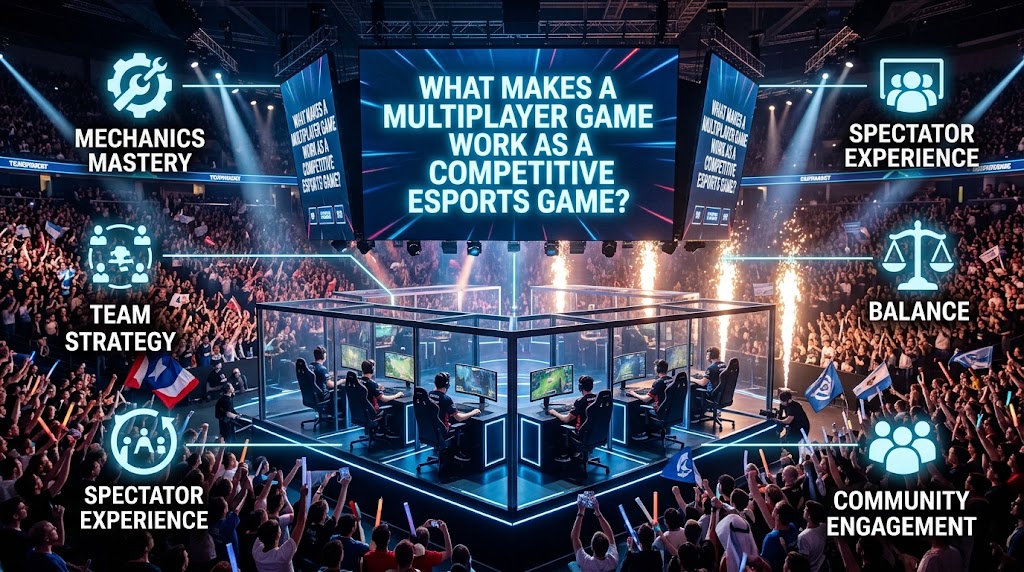
Becoming a real esport isn’t one thing going right. It’s several things going right at once, and missing even one of them tends to be enough to sink the whole project.
A High Skill Ceiling
Mechanical skill is the most visible piece of this, and probably the most overrated on its own. Aim, reaction time, execution under pressure — these separate good players from bad ones, sure, but a game built purely around raw mechanics tends to plateau fast.
Once most serious players hit a similar mechanical ceiling, mechanics alone stop being the differentiator.
Decision-making is where the real separation happens long-term. Knowing when to engage, when to retreat, when to make a read that goes against what the obvious play would be — that’s the layer that keeps top players ahead of merely good ones for years instead of months.
Long-term mastery depends on both existing simultaneously. A game with high mechanical demand but shallow decision-making gets solved quickly and stops being interesting to watch or play at a high level.
A game with deep decisions but no mechanical execution requirement risks feeling more like a board game than a competitive video game. The best esports thread both needles at once.
The Importance of Game Balance
Character balance sounds like a technical detail until you watch a tournament where one hero or one loadout so obviously outclasses everything else that the strategic layer of the game basically disappears. Suddenly it’s not about who out-thought whom. It’s about who had access to the broken pick.
Weapons and abilities need the same scrutiny. A weapon that’s marginally too strong doesn’t just get used more — it gets used almost exclusively, and diversity in how matches actually play out collapses.
Competitive fairness depends on this balance holding roughly steady over time, which is a genuinely hard, ongoing job for developers. Games that patch too rarely stagnate around whatever’s currently overpowered.
Games that patch too aggressively frustrate players who’ve invested time mastering something that gets nerfed into irrelevance a month later. There’s no permanent solution here, just a constant balancing act that either gets taken seriously or doesn’t.
Map Design and Strategic Depth
Positioning only matters if the map actually rewards good positioning, which sounds obvious but plenty of maps fail at it. A flat, symmetrical layout with no real chokepoints or high ground removes an entire strategic dimension that a well-designed map would otherwise offer.
Objectives placed thoughtfully on a map create natural flashpoints — areas worth fighting over specifically because controlling them provides a real advantage, not just because the game arbitrarily marks them as important.
Map control becomes a resource in its own right once that’s true, something teams can fight for and hold the same way they’d fight over any other in-game advantage.
Tactical decisions cascade from there: where to rotate, when to contest an objective versus concede it and reposition, how to read an opponent’s map presence and react before they commit to a play.
None of that works on a poorly designed map, no matter how mechanically demanding the core gameplay is.
Clear Competitive Objectives
Win conditions need to be legible, both to the players competing and to anyone watching from outside. A game where it’s genuinely unclear what’s currently winning or losing, even to an attentive viewer, struggles to build any real audience beyond people who’ve memorized every underlying system.
Scoring systems reinforce this same need for clarity. Points, rounds, objectives captured — whatever the metric, it needs to map cleanly onto something a viewer can track without a rulebook open in another tab.
Round structure ties it together by giving a match a rhythm: discrete segments with their own stakes, rather than one long undifferentiated stretch of play where it’s hard to tell when anything actually mattered.
Games that get this right make it possible for someone to glance at a screen mid-match and understand roughly what’s happening. Games that don’t tend to stay niche regardless of how deep the underlying systems actually are.
Matchmaking and Competitive Integrity
Skill-based matchmaking does more for a game’s competitive future than most players give it credit for. Get stomped repeatedly by opponents far above your level, and most people quit before ever discovering whether they’d have enjoyed the game at a fairer skill bracket.
Cheating prevention matters just as much, arguably more at higher levels of play. A competitive scene that can’t guarantee fair conditions loses credibility fast, and once players start suspecting matches aren’t clean, rebuilding that trust takes far longer than it took to lose it.
Fair competition, at the end of the day, is the entire premise a competitive scene rests on. Remove confidence in that fairness, and you don’t have an esport anymore. You just have a game people used to take seriously.
Why Spectator Experience Matters
Easy-to-understand objectives make the difference between a game that’s fun to play and a game that’s also fun to watch, which turn out to be genuinely separate qualities that don’t automatically come as a package.
Plenty of deep, mechanically interesting games are still miserable to spectate because there’s no clear read on what’s happening from outside.
Visual clarity plays into this directly. Can a viewer tell who’s winning an engagement at a glance? Can they follow the flow of a match without narration constantly filling in context the visuals fail to provide? Broadcast potential is really just the sum of both of these.
A game that’s legible and visually clear translates well to a stream or a broadcast; a game that requires deep system knowledge just to follow along limits its own audience to people who already play it, which caps growth in a way that’s hard to reverse later.
The Role of Community and Player Retention
An active player base is the foundation everything else gets built on top of. No amount of tournament investment matters if the underlying game can’t hold enough regular players to sustain a healthy competitive pool feeding into it.
Community tournament formats, even small unofficial ones, are usually the earliest sign that a game has real competitive potential worth developer investment. If players are already organizing their own brackets and finding their own prize money before any official support exists, that’s a much stronger signal than any marketing survey could provide.
Content creators extend that community’s reach well beyond the players actively competing. Someone who’d never enter a tournament themselves might still watch hours of tournament content because a creator they follow makes it engaging, and that secondary audience often ends up mattering as much to a scene’s long-term health as the competitors themselves.
Why Some Popular Games Never Become Major Esports
Lack of competitive depth kills plenty of otherwise successful games before they ever get a real shot. A game can sell millions of copies and still not have enough strategic layers to sustain years of high-level competition once the obvious strategies get solved and shared.
Poor spectator experience does in plenty of others that do have the depth. A genuinely deep game that’s confusing or visually unclear to watch will struggle to build an audience beyond its existing player base, no matter how compelling the competition looks to the people actually playing it.
Balance problems compound both issues — even a well-designed game becomes frustrating to compete in and to watch if the same handful of strategies dominate every match because the underlying systems were never tuned properly.
And developer support, or the lack of it, is often the deciding factor regardless of everything else. A publisher unwilling to invest in patches, tournament infrastructure, and long-term balance work can watch a genuinely promising competitive scene stall out and fade, not because the game failed on its own merits, but because nobody kept building on top of it.
A successful esport isn’t just a popular game that happened to attract competitive players. It’s an ecosystem — skill depth, balance, spectator clarity, community investment, and developer support all reinforcing each other at the same time. Miss one piece, and the rest can only carry the future of competitive gaming scene so far before it stalls out.
Leave a Reply