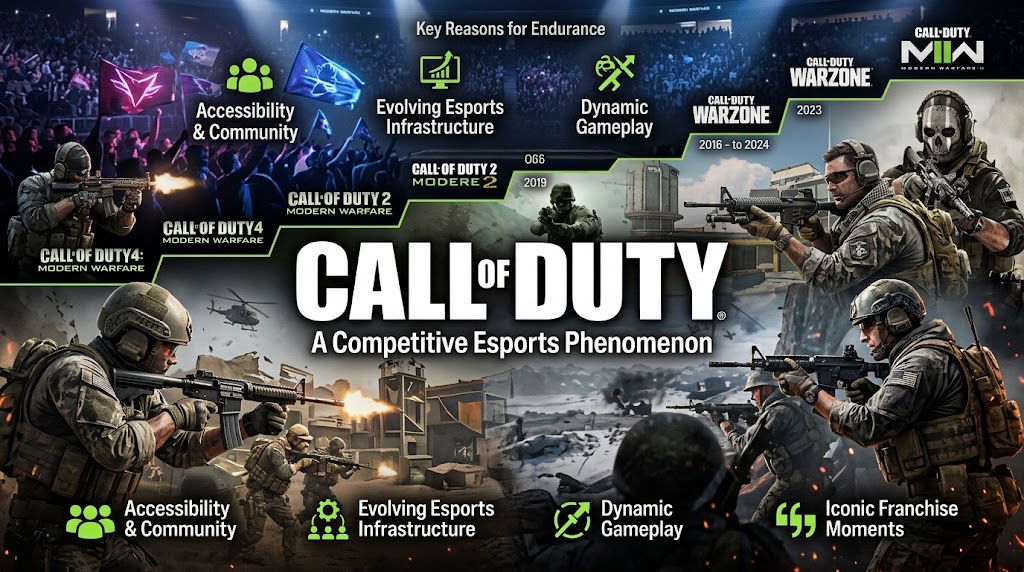
Plenty of shooters have had a moment. Fewer have had two decades of them. Call of Duty’s competitive scene has survived console generations, engine overhauls, at least one genuinely disastrous game, and more format experiments than most franchises would risk trying once.
That’s not just popularity carrying it — plenty of popular games never build a competitive scene that outlasts the hype cycle. Something about how the ecosystem was built made it durable in a way that’s worth actually picking apart.
The Competitive Roots of Call of Duty
The competitive instinct showed up almost immediately, and it didn’t come from the developers pushing it — it came from players who wanted a version of multiplayer with the randomness stripped out. LAN competition was the first real proving ground. No lag, no lobby drama, just whoever showed up with a rig and a mouse they trusted.
Community tournaments followed the same pattern you’d see in Competitive Gaming in Asia — a handful of committed organizers, prize pools that started as glorified entry-fee pots, and word-of-mouth as the only marketing.
Clan culture did a lot of the heavy lifting here. A tag in front of your name meant something. It signaled you belonged to a group that took the game seriously enough to practice together instead of just queuing solo, which is a small thing that mattered a lot more than it sounds.
Why Its Core Mechanics Work for Competition
Not every shooter translates to competitive play, and Call of Duty’s mechanics happen to hit a sweet spot most others miss. Time to kill is fast enough that decisions get made in fractions of a second, which rewards the kind of split-second reads that separate good players from great ones.
Aim mechanics are demanding but learnable — there’s a visible skill ceiling, but it’s not so punishing that new players bounce off immediately.
Movement adds another layer most people underrate. Strafing, sliding, positioning around corners — none of it works on its own, but combined with map knowledge it turns every engagement into a small tactical puzzle instead of a pure reflex test. Team coordination ties the rest together.
A player with perfect aim and no communication loses to a squad that’s calling out enemy positions and rotating together. That balance between individual mechanical skill and team-level decision-making is honestly the whole reason the competitive multiplayer format scene works.
The Importance of Map Design and Game Modes
Objective-based modes did more for competitive Call of Duty than deathmatch ever could. Search and Destroy, Hardpoint, Control — these force map control to actually mean something instead of just being a byproduct of where kills happen to occur.
Whoever holds the middle of the map usually dictates the pace of the round, and that’s a strategic layer deathmatch formats just don’t have.
Team roles emerged out of necessity once objectives got involved. Someone anchors a site, someone flanks, someone holds information duty and calls rotations.
None of this was written into a rulebook — it developed because objective-based modes punish teams that don’t divide responsibilities. Strategic decision-making stopped being optional at that point. You can’t out-aim your way through a well-set-up defense; you have to out-think it too.
From Community Competition to Organized Esports
Amateur tournaments were the training ground long before anything resembling a professional structure existed. Players cut their teeth in exactly the kind of grassroots events covered in Tournament Formats — single-elimination brackets, community-run, prize money that barely covered gas money for anyone who had to travel.
Professional teams started forming once it became clear the same rosters kept winning regardless of which local scene they entered.
Organized leagues formalized what had been ad hoc for years, and championships gave the whole thing a calendar and a season structure that amateur tournaments never had.
That structure mattered more than people give it credit for — a season means players can actually plan around competing instead of hoping the next tournament happens to line up with their schedule.
How Call of Duty Built a Spectator-Friendly Format
Watching competitive Call of Duty doesn’t require the viewer to understand ten years of meta history of esports competition, and that’s a genuine advantage over some of its FPS peers. Fast action keeps engagement high even for someone who wandered in without context.
Objectives are visually obvious — a bomb site, a hill to hold — so the stakes of any given moment read clearly even to a first-time viewer.
Team battles compress into short, digestible rounds instead of sprawling matches that demand a huge time commitment. That’s a real structural advantage for a spectator sport.
Short competitive moments mean highlight clips travel well on social media, which quietly does more for growing an audience than any marketing campaign the publisher runs.
The Franchise’s Ability to Adapt
New releases every year could have killed the competitive scene just as easily as they sustained it — annual iteration is a genuine risk when a community has to relearn a meta constantly.
Instead, gameplay changes mostly got absorbed rather than resisted, partly because the underlying skills — aim, movement, map sense — carry over even when a specific title’s mechanics shift.
New platforms and inevitably new consoles kept expanding who could actually play at a competitive level. Mobile expansion, through Call of Duty Mobile specifically, opened the door in regions where console and PC gaming were never realistic entry points to begin with — a pattern that echoes what happened with mobile titles more broadly in Competitive Gaming in Asia.
Each of these shifts could have fragmented the community. Somehow the core competitive identity held together anyway.
Why Competitive Communities Outlive Individual Games
This is maybe the least obvious part of the whole story. Individual Call of Duty titles come and go, but the community around competitive play doesn’t reset with each release — it carries forward.
Player familiarity with the broader systems, even across mechanical changes, means veterans don’t have to relearn the game from scratch every year the way a total newcomer would.
Skill development compounds across titles in a way that’s easy to miss from outside the scene. Aim discipline and map-reading instincts built on one game transfer to the next almost intact.
Community identity reinforces this further — the same organizations, the same rivalries, the same players people have followed for years, all of it persists even as the specific game underneath changes.
That continuity is arguably what makes a multiplayer game competitive in the first place: not the mechanics alone, but a community that keeps showing up for them.
Call of Duty’s Place in Competitive Gaming History
Legacy is a word that gets thrown around too easily, but in this case it’s earned. Call of Duty helped normalize competitive console shooters at a time when PC titles dominated the conversation almost completely.
Its influence shows up in how other franchises structure objective modes, build spectator formats, and think about balancing individual skill against team coordination.
Its relationship with the broader FPS esports landscape is less about competing for attention and more about proving a specific model works — fast, accessible, spectator-friendly competition doesn’t need a steep learning curve to sustain a serious scene.
Plenty of shooters have tried to replicate pieces of that formula since. Few have managed the whole package as consistently.
Long-term competitive success needs more than popularity. It needs mechanics that reward depth without punishing newcomers, formats that hold up on a screen for people who’ve never played the game, and a community willing to carry its identity forward through a decade of sequels. Call of Duty has all three, which is a rarer combination than the franchise’s mainstream reputation usually gets credit for.
Leave a Reply