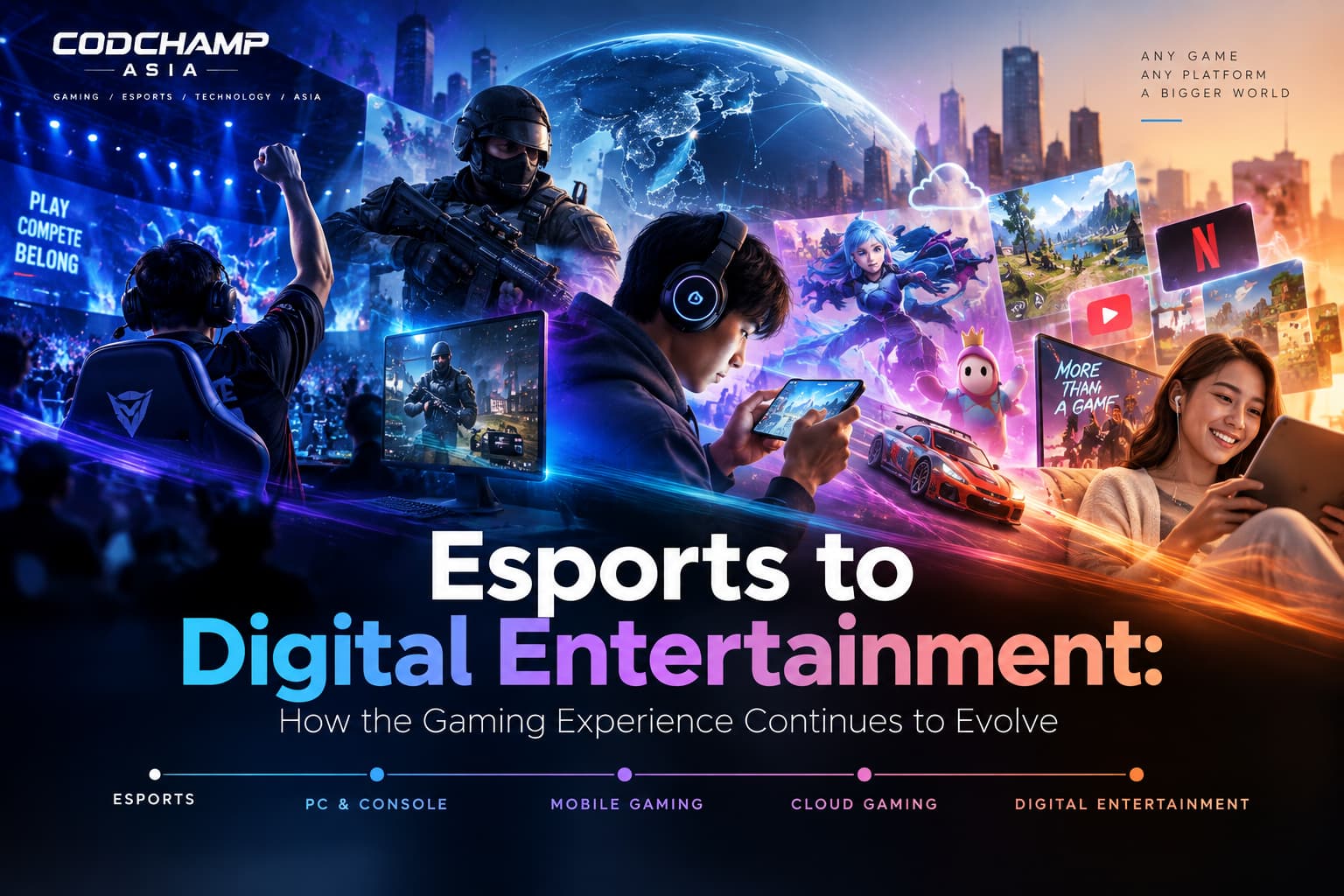
Competitive gaming used to demand a lot before you even got to the first match. Bulky desktop computers, equipment hauled to LAN events, games installed from physical discs, and whatever quirks the local network happened to throw at you that day. Esports grew out of that mess.
The technology wasn’t exactly convenient, but the appeal was straightforward enough: competition gave games a second life beyond whatever they were originally built for.
Fast forward, and competitive gaming is now a global spectator business. Smartphones turned into real gaming devices somewhere along the way, and browsers can now run interactive experiences that used to require dedicated software installs. The old boundaries around “gaming” have gotten blurry too.
Someone might jump from a competitive match to a streamer’s chat to a social feed to something casual on their phone, all in the same afternoon, without ever thinking of these as separate worlds.
That’s not just a bigger industry. It’s a different relationship with digital entertainment altogether.
Esports Helped Change What It Meant to Play
Participation was basically the whole point for early competitive gaming communities. You organized a tournament, joined a clan, traded strategies with people online, drove out to an event, because you wanted to find out how you stacked up against somebody real.
Then, at some point as the scene grew, a different crowd started showing up too. People who had no interest in competing themselves. They just wanted to watch.
Nobody planned for that split. It just happened, and it turned out to matter more than almost anything else that came out of early esports.
Because once that happened, a match wasn’t only a game anymore; it was also a show. You didn’t need to own the title. You didn’t need to know every mechanic inside out, or be good enough to compete yourself, to get something out of watching someone else make a brutal decision under pressure and pull it off (or completely blow it).
Streaming took that and ran with it. Instead of catching a recap after the fact, people could just watch it happen, live, with commentary running, player cams cutting in, stats on screen, chat scrolling by, and clips already circulating on social media before the match even ended.
At that point, gaming wasn’t just a thing between a player and a machine anymore. There was a whole ecosystem sitting around it, and that ecosystem ended up reshaping digital entertainment well past esports itself.
The Smartphone Changed the Definition of a Gaming Device
Hardware used to be what defined a gaming community. PC people had their world, console people had theirs, and portable gaming sat in its own little corner off to the side. Smartphones blew that up. The same phone someone used for texting, checking maps, taking photos, banking, listening to music, whatever, turned out to also be a perfectly good gaming device. And unlike a console or a gaming PC, it was already in everyone’s pocket to begin with.
That changed when and where a digital experience could even happen. No more blocking off a whole evening for a game. Five minutes on the bus counted now. So did standing in line for food, or those dead ten minutes between meetings.
Developers caught on fast: touch got friendlier, sessions got shorter, accounts started following you around, and games stopped assuming you’d sit still at a desk for three hours straight.
None of this killed off PC or console gaming. It just widened when and where people expected to be entertained. Convenience turned into part of the product.
The Browser Quietly Became Capable Again
Browser gaming has had a few different lives at this point. The first one ran on pure accessibility: click a link, land in a playable game, no store trip, no clunky install. Flash basically was that entire era of small web games. When Flash finally got killed off, it looked like it might take that whole scene down with it.
Didn’t happen. HTML5 crept in, JavaScript got a lot more capable, WebGL showed up, browser engines got faster, hardware acceleration improved, and somewhere in there, browsers quietly started doing things that would’ve seemed impossible for them a decade earlier.
Here’s why that’s not a small detail: installing something is friction, full stop. Every extra step between finding a thing and actually using it is one more chance for someone to just… not bother. Sure, downloading a big client and juggling three accounts and keeping everything updated is a fair price to pay for a game someone’s already obsessed with. Nobody’s doing that for something they’re only mildly curious about.
Modern browser-based entertainment platforms such as slot gacor lean into the opposite philosophy. The browser itself becomes the access layer, letting an experience start without asking anyone to reorganize their device around it. It sounds like a mundane principle, but it’s become one of the defining expectations of digital life now: click, open, continue.
Players Became Users Across Multiple Screens
The old picture of a gamer parked in front of one dedicated machine only covers part of the audience now. People bounce between devices without really thinking about it. Discover a game from a phone while scrolling social media, catch a tournament on the TV later that night, skim a strategy guide on a laptop the next morning, then actually sit down and play on a desktop over the weekend. The activity keeps shifting shape, but somehow people still expect their progress and their identity to just follow along.
Developers have had to chase that expectation with responsive interfaces, synced accounts, cloud-based data, cross-device everything. It’s changed what matters in the first few seconds too. Shrinking a desktop layout down to fit a phone screen doesn’t cut it anymore. Buttons have to work for a thumb, not just a mouse cursor. Text can’t get lost at a smaller size. And a connection that’s rock solid on home broadband might turn shaky the second someone steps onto a mobile network.
None of that shows up in a trailer or an ad. But it’s usually the reason someone sticks around or bounces off within the first minute. The best tech, honestly, is the stuff you stop noticing.
Competition Is Only One Kind of Engagement
Esports proved competition alone can hold a community together for years. But plenty of digital experiences never touch a ranked ladder or a professional tournament and still thrive. Some people are chasing mastery.
Others just like watching a number go up, collecting things, poking around to see what breaks, chatting with people, or killing ten minutes on something forgettable. Even within one single game, ask five different players why they keep coming back and you’ll probably get five different answers.
Which is basically why digital entertainment as a whole looks the way it does now, sprawling and hard to pin down. Somebody watches an esports grand final Saturday night, then spends Monday’s commute on something completely mindless on their phone.
That same person might browse streaming clips over lunch, drop into an online community after dinner, or check out something like MarkasGacor while just poking around for something new.
From the user’s side, none of these activities feel like they belong to carefully separated industries. They’re just different options competing for the same limited resource: attention. And that competition has pushed platforms to think about a lot more than content alone.
Speed Became Part of User Experience
A decade ago, people were generally a lot more tolerant of digital friction. Software took time to install, websites loaded slowly, updates interrupted plans, and creating an account often meant filling out a long form.
Expectations have shifted since then. When one service loads instantly and another makes you sit through several unnecessary steps, people notice. When an interface responds smoothly on mobile while another feels like it was designed for a 2012 desktop, people notice that too.
This has turned performance into more than just a technical metric. Speed affects perception directly; a responsive platform feels modern before anyone’s even looked at its features, while a slow one can feel outdated no matter how sophisticated the technology underneath actually is. Gaming makes this especially obvious because the interaction never really stops. Delays that might be tolerable on a static webpage get frustrating fast when people expect immediate feedback, and that same lesson has started applying across digital entertainment more broadly.
Streaming Turned Playing Into a Social Experience
Streaming did more than just create an audience for professional esports. It changed how ordinary people encounter games in the first place. For a lot of players, the first experience with a new title isn’t playing it anymore, it’s seeing a clip, watching a creator pull off an unusual strategy, catching an unexpected moment from a tournament, or seeing someone share a funny failure on social media. Discovery happens before installation now, more often than not.
That’s blurred the line between gaming media and gaming itself. Watching, discussing, learning, and playing form more of a loop than separate activities. Communities can keep going even when individual members aren’t actively playing every day, since discussion, video, memes, guides, tournament results, and personalities all keep people connected to a game between sessions. It also explains why older titles can stay culturally relevant well past their expected commercial lifespan. A game with an active community around it is never just old software.
Older Games Found New Ways to Survive
Technological progress creates this assumption that newer experiences should automatically replace older ones. Gaming keeps proving that wrong. Players keep coming back to games whose graphics have been surpassed many times over, and while nostalgia explains part of that, nostalgia alone doesn’t sustain an active community for decades.
Strong mechanics age differently than technology does. A well-designed competitive system stays interesting because human opponents keep creating new situations, strategy keeps evolving, communities develop conventions and then challenge them, and players keep getting better at the same game. Modern distribution makes these older experiences easier to preserve and rediscover too, digital stores, compatibility layers, browser technology, cloud infrastructure, fan communities, and streaming can all stretch out a game’s practical lifespan well beyond what anyone originally planned.
The industry has slowly learned that modernizing something doesn’t always mean reinventing it. Sometimes better access is enough on its own.
Digital Entertainment Is Becoming Less Device-Dependent
Here’s maybe the bigger story underneath all of this: entertainment is slowly untangling itself from any one specific piece of hardware. Cloud gaming is the extreme version, the actual computing happens somewhere far away and your device just shows you the result and takes your inputs, but you don’t need full cloud streaming to see the same trend playing out everywhere. Your account lives online. Your progress just… shows up on whatever you’re using next. Media libraries tag along wherever you go. Browsers don’t care what OS they’re running on. A community you’re part of doesn’t care what device brought you there.
Developers ask a different question now because of it. It used to be “what can we build for this machine.” These days it’s closer to “how easily can somebody get to this from wherever they are,” which is a bigger mental shift than it sounds like. Hardware hasn’t stopped mattering, not even close; competitive gaming still lives and dies on latency, frame rates, decent displays, and input devices that don’t lag. It’s just that for most of what people actually play day to day, being easy to reach counts for almost as much as being powerful.
The Next Evolution May Be Mostly Invisible
The obvious stuff is coming: sharper graphics, smarter AI, faster networks, beefier cloud infrastructure, browsers doing things they couldn’t do last year. Fine. But the changes that’ll actually matter are probably the boring ones nobody bothers to write a headline about. A page that loads a hair faster than it used to. Your progress just being there when you switch devices, no syncing required on your end. A layout that doesn’t fall apart on a small screen. Jumping into multiplayer without twenty minutes of setup first. A game that used to be locked to one machine, suddenly playable from wherever you happen to be.
None of that is flashy. Nobody’s putting out a trailer for “loads slightly faster.” But stack enough of these small, unglamorous improvements on top of each other, and they end up changing how people actually behave, more than any single flashy feature does. Esports is honestly a good place to land on this point. It didn’t get culturally huge because somebody invented one big thing. It happened because faster internet, better games, streaming infrastructure, online communities, and better hardware all landed around the same time, and slowly, a lot of people realized watching someone else play could be just as much fun as playing themselves.
Leave a Reply