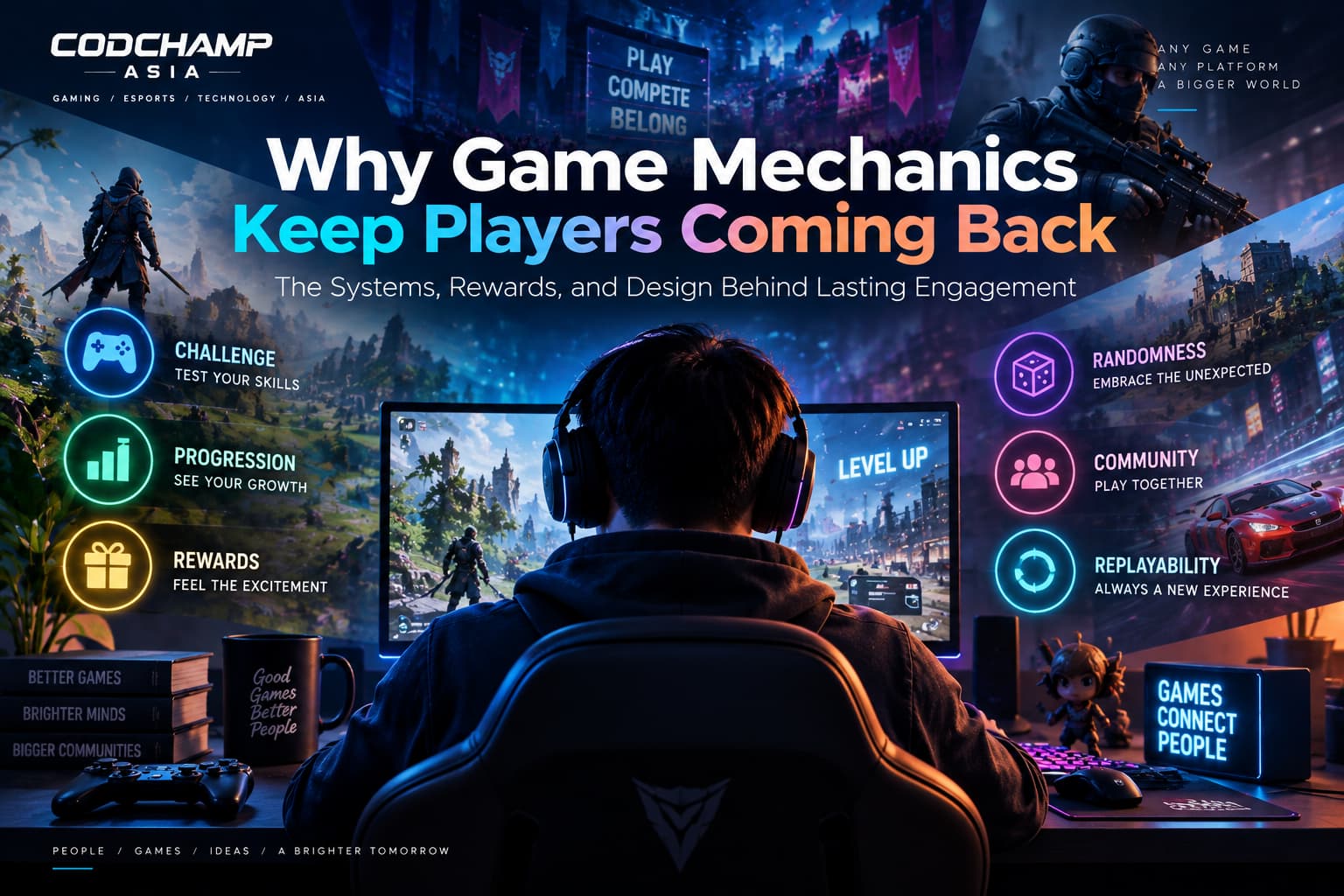
Graphics get you to click install. They don’t get you to open the app again three weeks later — that’s a different problem entirely, and mechanics are usually the ones quietly solving it, most of the time without you even noticing.
Mechanics are the rules underneath everything. Not the art style. What happens when you press a button, gamble on a risky play, screw up and want another shot at it. Nobody remembers a game for its textures ten years later. They remember whether it made them want to come back, and that almost always traces back to some mix of challenge, feedback, progression, reward, and the slow, grinding buildup of actually getting good at something.
What Are Game Mechanics?
Simplest version: a mechanic is a rule that produces an interaction. Move. Jump. Shoot. Trade. Build. Small system, one input, one consequence.
Three words get blurred together constantly, and they shouldn’t be. Mechanics are the individual rules. Gameplay is what happens once you stack several mechanics on top of each other in an actual moment of play. Game design is the bigger job — deciding which mechanics even belong in the game and how they’re supposed to talk to each other.
Movement, scoring, combat, progression, resource management, objectives. Boring in isolation, every single one of them. Stack them right and you’ve got the whole reason a game survives past launch week.
The Role of Challenge and Skill
Too easy and a game dies of boredom. Too hard and it dies of quitting. There’s a narrow band in between where most good design actually lives, and hitting it is harder than it sounds from the outside.
Skill development is what happens when a game actually notices you’re getting better and says so, one way or another. That acknowledgment — a smoother win, a cleaner execution, whatever form it takes — is what drags you back for one more round. Mastery is just that same loop stretched across months instead of a single evening.
Risk and reward tie into this directly. A mechanic that lets you gamble a safe position for a bigger payoff creates tension that pure execution never quite matches. That’s a big part of what gives competitive multiplayer games their depth — every decision carries a cost, and skilled players are the ones who read that cost correctly more often than their opponents.
Why Progression Gives Players a Reason to Continue
Levels, rankings, unlocks, achievements. All of these give you a reason to play the next match instead of stopping after this one.
Worth being precise here, though. Progression isn’t the same thing as a simple reward. A reward is a one-time payout for an action. Progression is a structure — a visible path with a beginning, a middle, and a sense of where you’re headed. Rankings especially do this well, since they turn every match into a data point in a larger story rather than an isolated result.
Milestones matter for a similar reason. They break a long grind into smaller, achievable chunks, which keeps motivation from collapsing under the weight of a goal that feels too far away to bother chasing.
Feedback Loops and the Feeling of Improvement
Immediate feedback tells you, right now, whether what you just did worked. A hit marker, a score tick, a visual cue. Small, but it’s doing constant, quiet work to keep you oriented inside the game.
Delayed feedback operates on a longer timeline. A rank going up at the end of a season, a stat sheet reviewed after a match, a skill tree that only pays off ten hours later. Both timescales matter, and games that only use one tend to feel either shallow or aimless.
Winning and losing are the most obvious feedback signals, but performance indicators do more of the actual teaching. A damage breakdown, an accuracy percentage, a heat map of where you died. These are what actually let a player learn from a loss instead of just feeling bad about it.
The Psychology of Reward Systems in Game Design
Predictable rewards, the same payout every time you complete an action, build a reliable habit. You know what you’re getting, and that consistency is part of the appeal for certain kinds of players.
Variable rewards behave differently. When a payout isn’t guaranteed every time, anticipation plays a bigger role in the moment leading up to it. This is a well-documented pattern in behavioral research generally, though it’s worth being careful about applying it too broadly. Not every player responds to variable rewards the same way, and treating any single mechanic as a guaranteed engagement lever oversimplifies what’s actually a fairly individual response.
Reward frequency and player expectations interact constantly. A game that trains players to expect frequent payouts, then suddenly slows down, tends to see frustration rise even if the total reward amount hasn’t actually changed. Expectation, once set, is hard to walk back without cost.
Where Randomness Fits Into Game Mechanics
Randomness sits in an odd spot. Too little of it and a game feels solved the moment the optimal strategy gets discovered. Too much and skill stops mattering at all.
Probability-driven systems, procedural generation, random item drops, all of these introduce genuine uncertainty into outcomes that would otherwise be fully determined by skill alone. Used carefully, that uncertainty keeps a solved-feeling game interesting for longer, since even a “correct” strategy doesn’t guarantee a “correct” result every time.
Used carelessly, randomness undermines the very skill expression a competitive game depends on. There’s a deeper conversation to be had specifically about how randomness in game design gets tuned well versus poorly, since the difference between the two is often a matter of degree rather than a clean line.
Why Familiar Mechanics Can Create Long-Term Communities
Mastery takes time, and time invested in a specific mechanical system builds a kind of loyalty that’s hard to replicate with a brand-new game. Players who’ve spent years learning a system don’t want to start over.
Familiarity compounds this. Established strategies, community knowledge, years of accumulated meta discussion, all of it becomes a shared asset a community builds together and doesn’t want to abandon lightly. This is a big reason certain games maintain competitive scenes for a decade or longer, a pattern worth exploring further in the context of competitive game longevity specifically, where mechanical stability turns out to matter more than most players initially assume.
When Game Mechanics Become Too Predictable or Too Random
Too predictable, and a game gets solved. Once the optimal line of play is known and repeatable, skill expression collapses into execution alone, and replayability drops off a cliff.
Too random, and player agency suffers instead. If outcomes depend more on chance than decision-making, skilled players lose their edge, and the game starts to feel arbitrary rather than fair. Frustration builds quickly once players sense that their choices don’t actually control the outcome.
The healthiest mechanical systems sit between these two failure states, giving players enough consistency to develop real skill while leaving enough uncertainty that matches don’t all play out identically.
Designing Mechanics for Different Types of Games
FPS lives or dies on split-second reads. Fast, precise, almost no room to think — mechanics here reward whoever executes cleanest under pressure, full stop. MOBAs run on the opposite clock. One mechanical slip thirty minutes into a match barely registers next to a pattern of good decisions sustained across the whole game.
Fighting games compress everything down to a handful of seconds where a single correct guess flips the entire round. Sports titles borrow their rhythm from whatever they’re simulating, which means the mechanics were never really invented from scratch so much as translated from something that already existed. Strategy games slow everything back down, betting on planning over reflexes. And casual games go a completely different direction, stripping friction out entirely because the goal there was never deep mastery, just an easy way back in for five minutes at a time.
Point is, none of this transfers cleanly. A mechanic that’s brilliant in a fighting game can be dead weight in a strategy title, because the two genres aren’t even trying to produce the same feeling in the player.
Strip it down and game longevity keeps coming back to the same short list, just remixed depending on genre: real challenge, honest feedback, visible progress, a real shot at mastery, decisions that actually cost something. Graphics get someone through the door once. Mechanics are what decide if they ever come back.
Leave a Reply