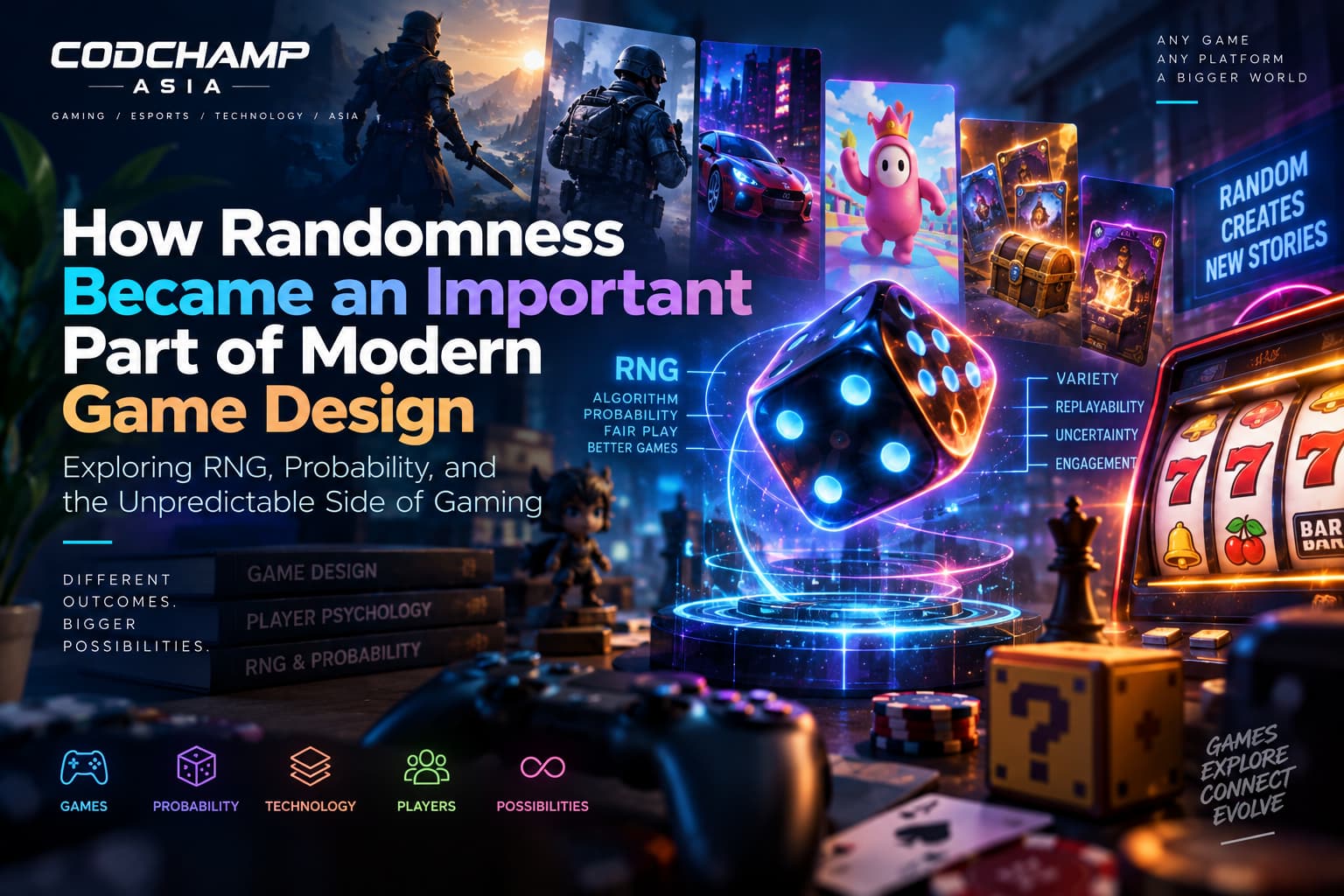
Not every outcome in a game needs to be predictable. Obvious once you say it. Took the industry decades to actually build around that idea instead of treating unpredictability as something to stamp out.
Dice existed long before video games did, so randomness itself isn’t new. What’s new is scale. Software can juggle millions of random outcomes at once, something a physical die never had to do, and that scale turned randomness from a curiosity into an actual design tool. Used right, it drives replayability, keeps outcomes honestly uncertain, adds variety without adding budget, and creates tension nothing deterministic can fake.
What Does Randomness Mean in Game Design?
Deterministic is easy: same input, same result, every time. Random flips that. Same input, different possible results, and probability decides which one you get.
Picture it as a slider, not a switch:
100% predictable
       ↓
controlled variation
       ↓
probabilistic outcome
Nearly every game sits somewhere in the middle of that slider. Your character’s base stats might be locked in stone. Whether your next hit crits? That’s rolling dice underneath the hood, whether the game shows you the dice or not.
The Role of Random Number Generators
An RNG does what the name says. Produces numbers that act unpredictable. Most game RNGs aren’t truly random though, they’re pseudo-random, spit out by an algorithm instead of something like radioactive decay. Know the starting seed and technically you could predict every output. Nobody does, so it functions as random to everyone actually playing.
That seed is just the number the algorithm starts from. Change it, get a different sequence entirely. Ever seen a “seed code” in a procedurally generated game, something you can type in to get someone else’s exact map? That’s this, exposed to the player directly instead of buried in the code.
Probability distribution is the part people misread most often. A 20 percent crit chance isn’t a coin flip dressed up in different math. It’s a weighted average that only makes sense across a lot of attempts. Any single swing could go either way. Ask a Dota player who’s missed six 25 percent chances in a row how “random” it felt in the moment.
Why Game Designers Use Randomness
Replayability, first and most obvious. Same level, different outcome each run, and suddenly there’s a reason to play content you’ve technically already beaten.
Uncertainty does something sneakier. It forces you to keep adapting instead of memorizing one solved sequence and repeating it forever. Take the randomness away and eventually every serious player converges on the exact same optimal line.
Variety leans on the same trick, just aimed at content instead of outcomes. Randomized enemy placement or loot tables make a small content budget feel a lot bigger than it actually is.
And tension is really just the emotional residue of all three combined. You can be favored to win and still feel your stomach drop when the dice haven’t actually rolled yet. A fully deterministic system can’t buy you that feeling at any price.
Randomness in Competitive Games
Here’s where it gets genuinely messy. Item spawns, map picks, damage variance, crits, card draws, loot, all of it drags chance into an arena where players showed up expecting skill to be the only thing that decides who wins.
So the real question isn’t whether randomness belongs in competitive games. It’s how much. Too little and matches start feeling solved, identical, dead. Too much and skill stops mattering at all, which is basically the death of competitive integrity in one sentence.
Skill versus luck is the fight underneath everything here. Fairness needs randomness to hit both players roughly evenly over time, not hand one side a free win through pure chance. Player agency is the other half of that coin. Good random systems still let smart decisions shape the odds, even without guaranteeing the result. That balance, more than almost anything else, is what separates a competitive game people trust from one they quietly stop taking seriously.
Loot Systems and Randomized Rewards
Worth drawing a hard line here, because two very different things keep getting lumped together under “randomized rewards.” Random content generation, varied enemies, cosmetics, layouts, exists to keep a game from feeling stale. That’s design in service of the player.
Monetized randomized rewards are a different animal. Real money buying a shot at a random outcome isn’t the same conversation at all, and pretending otherwise does readers a disservice. A loot drop in a game you already bought once is one thing. A system charging you again and again for another roll of the dice raises real questions, transparency about actual odds, how deliberately the system is tuned to keep you spending. Treating every randomized reward system as identical flattens a distinction that actually matters.
Randomness Beyond Traditional Video Games
RNG doesn’t stay inside conventional video games. Card games build their entire identity around the shuffle, turning what’s technically just randomization into the core mechanic itself, not an afterthought bolted on.
Arcade-style games lean on random elements to keep a five-minute session from feeling like the last five-minute session. Simulation games throw in unpredictable events specifically so long-term play doesn’t turn into a scripted routine you’ve already memorized. Casual games use the lightest touch of all, just enough variation to stop the tenth play session from feeling exactly like the first.
Worth a quick mention of casino-style formats too, purely as a reference point. A spinning reel landing on a random combination is, mechanically, just a probability distribution rendered visually, nothing more exotic than that. It’s useful the same way a coin flip is useful for teaching fifty-fifty odds, an extreme, stripped-down case where randomness is the entire mechanic and nothing else is competing for attention. Not an endorsement of anything, just the cleanest example available of RNG with no other systems muddying the picture.
How Digital Technology Changed Randomized Game Experiences
Dice, shuffled decks, spinning wheels, all replaced by algorithms that run instantly and, unlike a die on a table, can actually be logged and audited afterward.
Real-time systems mean a random roll resolves the instant it’s needed, no pausing the action for some physical gesture, which matters a lot once you’re talking about fast competitive games where a pause would kill the pacing. Mobile brought RNG to an audience orders of magnitude bigger than PC gaming ever reached alone, and mobile titles lean on randomized rewards especially hard as a core hook. Browser games pushed reach further still. And a lot of this randomization now happens server-side rather than on your device, which actually matters for trust, since an outcome generated remotely is a lot harder to tamper with than one sitting in local code. None of it scales without the broader infrastructure the whole industry’s been building for twenty years.
Randomness vs Skill: Finding the Right Balance
Another spectrum, not a binary:
Pure skill
   ↓
Skill + limited randomness
   ↓
Heavy randomness
   ↓
Primarily chance-based
A fighting game lives near the pure-skill end. Throw randomness in there and you’ve broken the entire premise of a genre built on reads and reaction time. A trading card game sits further along, since a random draw is part of the puzzle rather than a threat to it. Party games can slide almost all the way to the chance-heavy end, because the goal was never rigorous fairness, it was fun in a room full of friends.
No universal right answer here. Every genre needs its own calibration, and pretending one setting fits everything is how you end up with a game that feels wrong for what it’s trying to be.
Why Players Respond Differently to Uncertainty
Anticipation is the wait itself, the space between rolling and finding out, and that gap is doing more emotional work than people give it credit for. Surprise is what happens once the result actually lands, confirming or blowing past whatever you expected.
I want to be careful here rather than reach for a tidy explanation that oversells itself. It’s tempting to just say randomness hooks people through some universal psychological switch, but that’s flatter than reality actually is. Plenty of players love the uncertainty. Plenty of others find it genuinely stressful and steer clear of anything built around heavy randomization on purpose. Wanting predictability isn’t a flaw in a player. It’s just a different preference, and design that assumes everyone wants the same dose of chance is design that’s ignoring half its audience.
Where Randomness in Game Design Is Heading
AI-assisted procedural generation is nudging randomness toward something less purely arbitrary, content that’s varied but still shaped by intentional design rather than left entirely to chance.
Dynamic systems now adjust based on how you specifically are playing, which starts to blur randomness into something closer to slot gacor personalization. Cloud gaming opens room for heavier server-side randomization than any single device could handle on its own. Personalization pushes that further, tuning odds to individual behavior instead of running one fixed table for every player. Where this all lands connects directly to bigger open questions about where competitive gaming is headed generally, since fairness and personalization don’t always want the same thing.
Randomness was never just a way to spit out an unpredictable number. In game design, it’s a lever for variety, uncertainty, replayability, and tension, all pulling from the same mechanic. The bigger that lever gets, the more a game’s design owes players real transparency, real balance, and honest expectations about what they’re actually rolling for. Get that wrong, and the exact thing that made a game exciting is the same thing that eventually drives people away from it.
Leave a Reply