Author: admin

  • How Better Internet Infrastructure Changed Competitive Gaming Across Asia

    How Better Internet Infrastructure Changed Competitive Gaming Across Asia

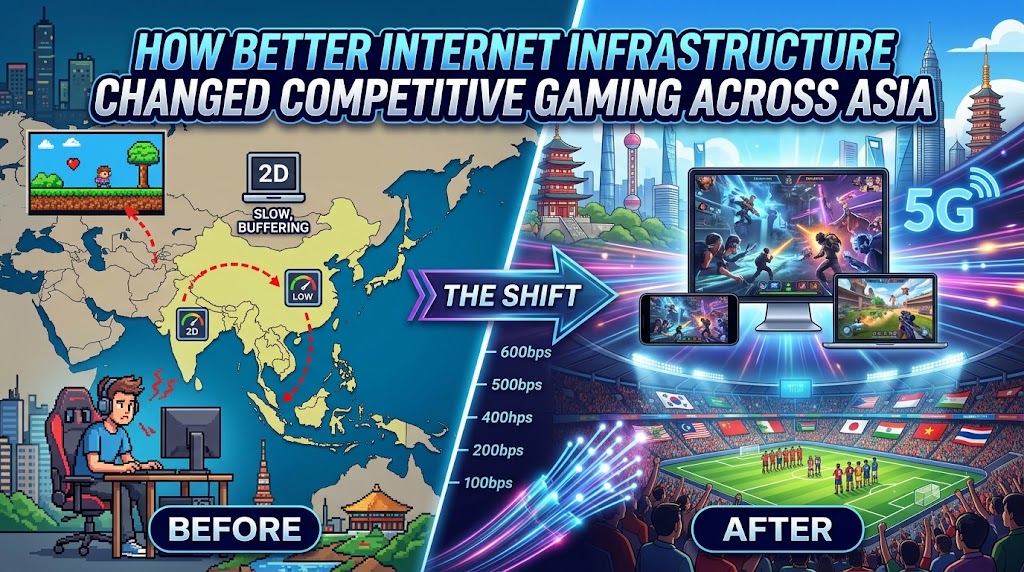
    Nobody cheers for a server. When a team wins a tournament, the highlight reel shows the clutch play, not the data center that made it possible without a hitch. But ask any player who competed through the dial-up era and they’ll tell you the infrastructure was the actual story half the time — matches decided less by skill than by whose connection happened to hold up that day.

    Why Latency Matters

    Ping is the number everyone complains about, but what it actually measures is simple: how long it takes a signal to travel from your machine to the server and back. Lower is better, and the difference between 20ms and 150ms isn’t subtle once you’re playing anything that requires split-second reactions.

    Response time compounds on top of that raw ping figure. Your input has to travel to the server, get processed, and come back before you see the result on screen, and every extra millisecond in that round trip is a millisecond where the game state on your screen and the actual game state have quietly drifted apart. Server distance is usually the biggest lever affecting all of this. A player in Jakarta connecting to a server in Los Angeles is fighting geography as much as their opponent, and no amount of individual skill fully compensates for a connection that’s physically routing halfway around the planet and back.

    The Early Limitations of Online Gaming

    Dial-up internet made competitive online play borderline unworkable for anything demanding real-time precision. Connections that maxed out around 56 kilobits per second simply couldn’t carry the kind of fast, continuous data exchange that competitive multiplayer needs to feel responsive.

    Unstable connections made things worse on top of already-slow speeds. Dropped packets, sudden disconnects mid-match, connections that worked fine for an hour and then inexplicably fell apart — none of this was rare, and tournament organizers in the early 2000s built entire contingency plans around the assumption that someone’s connection would fail at some point during the event. Limited bandwidth capped how much data could move at once regardless of latency, which meant even players with decent ping still dealt with visual stutters and inconsistent performance whenever a match got genuinely intense. Competitive online and lan gaming in this era worked more as a proof of concept than a reliable format.

    Broadband Changed Multiplayer Gaming

    Broadband didn’t just make things faster. It made them consistent, which mattered just as much if not more. Faster connections cut down the raw latency numbers, but the bigger shift was that connections stopped randomly failing mid-session the way dial-up regularly did.

    More stable sessions meant tournaments could actually plan around online play instead of treating it as a fallback for when LAN wasn’t feasible. Larger communities followed almost immediately once that reliability was in place. Players who’d never had access to a LAN cafe, or who lived somewhere without a local competitive scene at all, could suddenly compete online at a level that felt fair rather than handicapped by their connection. That expansion of who could realistically compete is arguably broadband’s biggest long-term contribution to competitive gaming, bigger than the raw speed improvement itself.

    The Expansion of Regional Game Servers

    Local servers solved a problem broadband alone couldn’t fix. Even with a fast connection, a player routing to a server on the other side of the world was still stuck with geography-driven latency that no amount of bandwidth improvement would fully erase.

    Regional servers changed that equation by putting infrastructure physically closer to where players actually were. A data center in Singapore serving Southeast Asian players cuts out thousands of kilometers of unnecessary travel time compared to routing everyone through a server built primarily for a North American or European player base. Lower latency followed directly from that proximity, and the difference wasn’t marginal — players who’d been competing at a structural disadvantage for years suddenly found themselves on genuinely even footing with opponents from regions that had always had better server access.

    Mobile Connectivity Changed the Equation

    4G networks did for mobile gaming roughly what broadband did for PC gaming a decade earlier, and the timing mattered enormously for a region where mobile was already becoming the dominant gaming platform. Suddenly competitive mobile titles could actually function at a level serious enough to support real tournaments, not just casual play.

    5G is pushing further still, chipping away at the specific latency issues that used to make competitive mobile gaming noticeably less responsive than PC or console play. Mobile esports grew directly out of this connectivity improvement — games like Mobile Legends and PUBG Mobile built massive, genuinely serious competitive scenes across Southeast Asia specifically because the mobile networks finally got good enough to support real-time competition reliably, not just casual matches where an occasional lag spike didn’t much matter.

    Infrastructure and Cross-Border Competition

    Players from different countries connecting to the same server or the same tournament bracket introduces a fairness question that a single-country tournament never has to deal with. Whoever’s geographically closer to wherever the server is hosted gets a built-in latency advantage that has nothing to do with skill.

    Regional tournaments have had to account for this directly, sometimes rotating server locations between events or working with organizers to pick neutral hosting that doesn’t systematically favor one country’s players over another’s. Online qualifiers face the same challenge in a more distributed way, since qualifying rounds often can’t guarantee every competitor is playing under identical network conditions the way a single LAN venue would. It’s a problem infrastructure keeps chipping away at, but it hasn’t fully disappeared, and probably won’t until server distribution gets a lot more even across the whole region than it currently is.

    Why Infrastructure Is Part of Competitive Fairness

    Latency differences between competitors aren’t just a technical footnote. They’re a fairness issue on the same level as game balance or matchmaking integrity, even though they get talked about far less. A player with a 20ms advantage over their opponent has a real edge in any game where reaction time matters, regardless of how skilled both players actually are.

    Connection stability factors in just as heavily. A player whose connection drops mid-match, even briefly, can lose a game they were otherwise winning through no fault of their own skill or strategy. Server reliability ties both of these together at the infrastructure level — a tournament built on unreliable servers puts every competitor at the mercy of technical issues that have nothing to do with who’s actually better at the game, which undermines the entire premise of the competition being decided on merit.

    What’s Next: Edge Computing and Cloud Technology

    Edge servers are pushing the “put infrastructure closer to players” logic even further than regional servers already have, distributing computing resources across many more physical locations rather than just a handful of major regional hubs. The goal is shrinking that remaining distance-driven latency gap even for players outside major cities.

    Cloud gaming is trying to solve a different but related problem: removing hardware as a barrier entirely by shifting the actual processing off a player’s device and onto remote servers. It’s a promising idea that’s still constrained by exactly the infrastructure challenges this whole article has been about — cloud gaming is only as good as the connection carrying it, and that connection still needs to be fast and stable enough to not introduce the very latency problems the technology is meant to eliminate. Reduced latency is the throughline connecting all of this. Every infrastructure shift over the past two decades, from broadband to regional servers to mobile networks to whatever edge computing eventually becomes, has been chasing the same basic goal: get the gap between a player’s action and the game’s response as close to zero as physically possible. Competitive gaming across Asia has been shaped by that pursuit as much as by any player, team, or tournament that gets the credit for how far the scene has come.
  • What Makes a Multiplayer Game Work as a Competitive Esports Game?

    What Makes a Multiplayer Game Work as a Competitive Esports Game?

    Here’s a game that never made it: a mid-2010s shooter with a decent player count, solid production values, and a publisher who genuinely wanted it to become the next big esport.

    They ran tournaments. They put up prize money. It fizzled anyway, and if you ask people who followed the scene why, you’ll get half a dozen different answers depending on who you talk to. That’s actually the point.

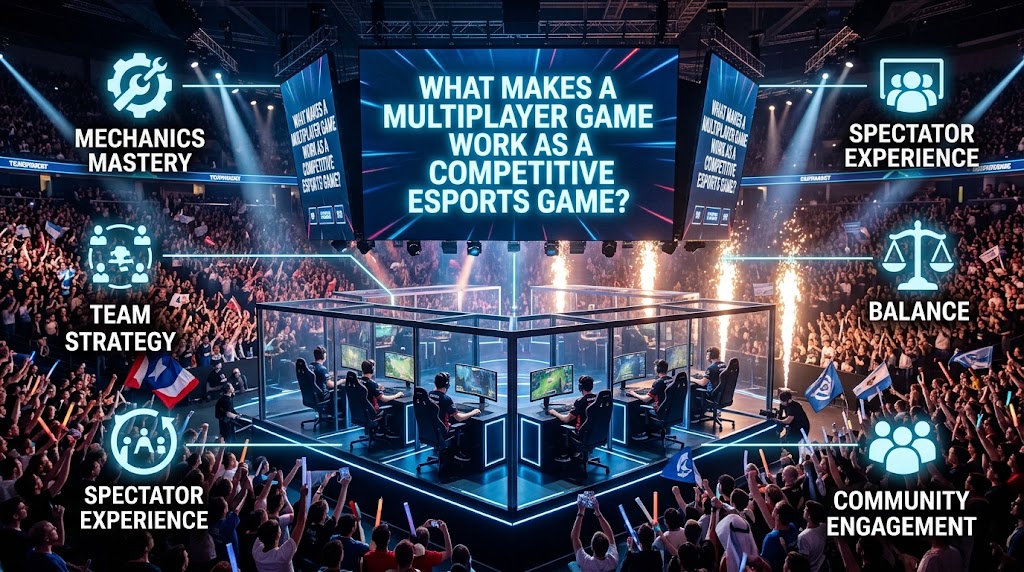
    Becoming a real esport isn’t one thing going right. It’s several things going right at once, and missing even one of them tends to be enough to sink the whole project.

    A High Skill Ceiling

    Mechanical skill is the most visible piece of this, and probably the most overrated on its own. Aim, reaction time, execution under pressure — these separate good players from bad ones, sure, but a game built purely around raw mechanics tends to plateau fast.

    Once most serious players hit a similar mechanical ceiling, mechanics alone stop being the differentiator.

    Decision-making is where the real separation happens long-term. Knowing when to engage, when to retreat, when to make a read that goes against what the obvious play would be — that’s the layer that keeps top players ahead of merely good ones for years instead of months.

    Long-term mastery depends on both existing simultaneously. A game with high mechanical demand but shallow decision-making gets solved quickly and stops being interesting to watch or play at a high level.

    A game with deep decisions but no mechanical execution requirement risks feeling more like a board game than a competitive video game. The best esports thread both needles at once.

    The Importance of Game Balance

    Character balance sounds like a technical detail until you watch a tournament where one hero or one loadout so obviously outclasses everything else that the strategic layer of the game basically disappears. Suddenly it’s not about who out-thought whom. It’s about who had access to the broken pick.

    Weapons and abilities need the same scrutiny. A weapon that’s marginally too strong doesn’t just get used more — it gets used almost exclusively, and diversity in how matches actually play out collapses.

    Competitive fairness depends on this balance holding roughly steady over time, which is a genuinely hard, ongoing job for developers. Games that patch too rarely stagnate around whatever’s currently overpowered.

    Games that patch too aggressively frustrate players who’ve invested time mastering something that gets nerfed into irrelevance a month later. There’s no permanent solution here, just a constant balancing act that either gets taken seriously or doesn’t.

    Map Design and Strategic Depth

    Positioning only matters if the map actually rewards good positioning, which sounds obvious but plenty of maps fail at it. A flat, symmetrical layout with no real chokepoints or high ground removes an entire strategic dimension that a well-designed map would otherwise offer.

    Objectives placed thoughtfully on a map create natural flashpoints — areas worth fighting over specifically because controlling them provides a real advantage, not just because the game arbitrarily marks them as important.

    Map control becomes a resource in its own right once that’s true, something teams can fight for and hold the same way they’d fight over any other in-game advantage.

    Tactical decisions cascade from there: where to rotate, when to contest an objective versus concede it and reposition, how to read an opponent’s map presence and react before they commit to a play.

    None of that works on a poorly designed map, no matter how mechanically demanding the core gameplay is.

    Clear Competitive Objectives

    Win conditions need to be legible, both to the players competing and to anyone watching from outside. A game where it’s genuinely unclear what’s currently winning or losing, even to an attentive viewer, struggles to build any real audience beyond people who’ve memorized every underlying system.

    Scoring systems reinforce this same need for clarity. Points, rounds, objectives captured — whatever the metric, it needs to map cleanly onto something a viewer can track without a rulebook open in another tab.

    Round structure ties it together by giving a match a rhythm: discrete segments with their own stakes, rather than one long undifferentiated stretch of play where it’s hard to tell when anything actually mattered.

    Games that get this right make it possible for someone to glance at a screen mid-match and understand roughly what’s happening. Games that don’t tend to stay niche regardless of how deep the underlying systems actually are.

    Matchmaking and Competitive Integrity

    Skill-based matchmaking does more for a game’s competitive future than most players give it credit for. Get stomped repeatedly by opponents far above your level, and most people quit before ever discovering whether they’d have enjoyed the game at a fairer skill bracket.

    Cheating prevention matters just as much, arguably more at higher levels of play. A competitive scene that can’t guarantee fair conditions loses credibility fast, and once players start suspecting matches aren’t clean, rebuilding that trust takes far longer than it took to lose it.

    Fair competition, at the end of the day, is the entire premise a competitive scene rests on. Remove confidence in that fairness, and you don’t have an esport anymore. You just have a game people used to take seriously.

    Why Spectator Experience Matters

    Easy-to-understand objectives make the difference between a game that’s fun to play and a game that’s also fun to watch, which turn out to be genuinely separate qualities that don’t automatically come as a package.

    Plenty of deep, mechanically interesting games are still miserable to spectate because there’s no clear read on what’s happening from outside.

    Visual clarity plays into this directly. Can a viewer tell who’s winning an engagement at a glance? Can they follow the flow of a match without narration constantly filling in context the visuals fail to provide? Broadcast potential is really just the sum of both of these.

    A game that’s legible and visually clear translates well to a stream or a broadcast; a game that requires deep system knowledge just to follow along limits its own audience to people who already play it, which caps growth in a way that’s hard to reverse later.

    The Role of Community and Player Retention

    An active player base is the foundation everything else gets built on top of. No amount of tournament investment matters if the underlying game can’t hold enough regular players to sustain a healthy competitive pool feeding into it.

    Community tournament formats, even small unofficial ones, are usually the earliest sign that a game has real competitive potential worth developer investment. If players are already organizing their own brackets and finding their own prize money before any official support exists, that’s a much stronger signal than any marketing survey could provide.

    Content creators extend that community’s reach well beyond the players actively competing. Someone who’d never enter a tournament themselves might still watch hours of tournament content because a creator they follow makes it engaging, and that secondary audience often ends up mattering as much to a scene’s long-term health as the competitors themselves.

    Why Some Popular Games Never Become Major Esports

    Lack of competitive depth kills plenty of otherwise successful games before they ever get a real shot. A game can sell millions of copies and still not have enough strategic layers to sustain years of high-level competition once the obvious strategies get solved and shared.

    Poor spectator experience does in plenty of others that do have the depth. A genuinely deep game that’s confusing or visually unclear to watch will struggle to build an audience beyond its existing player base, no matter how compelling the competition looks to the people actually playing it.

    Balance problems compound both issues — even a well-designed game becomes frustrating to compete in and to watch if the same handful of strategies dominate every match because the underlying systems were never tuned properly.

    And developer support, or the lack of it, is often the deciding factor regardless of everything else. A publisher unwilling to invest in patches, tournament infrastructure, and long-term balance work can watch a genuinely promising competitive scene stall out and fade, not because the game failed on its own merits, but because nobody kept building on top of it.

    A successful esport isn’t just a popular game that happened to attract competitive players. It’s an ecosystem — skill depth, balance, spectator clarity, community investment, and developer support all reinforcing each other at the same time. Miss one piece, and the rest can only carry the future of competitive gaming scene so far before it stalls out.

  • Why Southeast Asia Became One of Gaming’s Most Passionate Competitive Markets

    Why Southeast Asia Became One of Gaming’s Most Passionate Competitive Markets

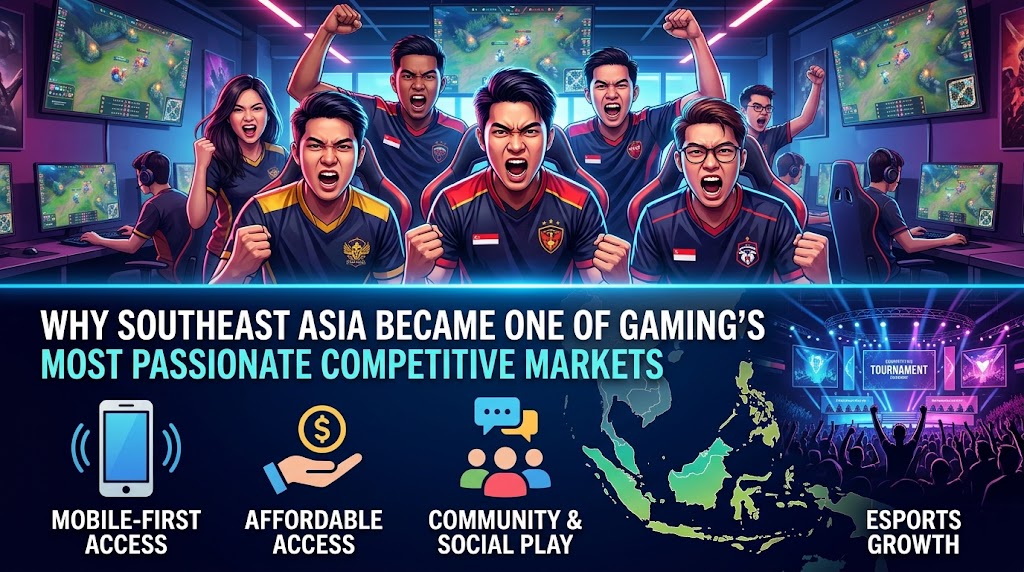
    Southeast Asia gets talked about as a gaming region mostly in terms of numbers — huge player counts, massive mobile download figures, that kind of thing. The numbers are real, but they’re not really the interesting part. What actually separates this region is the culture wrapped around the games, the way competition here grew out of community first and scale second. A lot of markets got big. Fewer got this attached to the process.

    A Region Built Around Gaming Communities

    Internet cafés did a lot of the early groundwork, the same way they did across most of Asia, but the flavor here was distinct. These weren’t just places to play — they were social hubs where showing up mattered as much as the game itself. You went because your friends were going, and the match was almost secondary to the hangout.

    Local communities formed around specific cafés and specific games the way neighborhoods form around a coffee shop. Gaming groups grew out of that repetition — the same faces, the same rivalries, week after week.

    Social gaming was baked into the culture from the start in a way that’s easy to underestimate if you’re comparing it to markets where gaming stayed a more solitary hobby for longer. Here, gaming was rarely something you did alone.

    The Impact of Affordable Internet and Smartphones

    Everything shifted once smartphones got cheap and internet got affordable, and it happened faster in Southeast Asia than in a lot of other regions with comparable income levels. Mobile-first audiences emerged almost by default rather than by trend — plenty of players in the region got online through a phone before they ever touched a home PC.

    Accessibility is really the whole story here. A smartphone costs a fraction of a gaming PC and does a hundred other useful things besides play games, which makes it a far easier purchase to justify for most households.

    Online multiplayer on mobile removed the last real barrier, letting players compete against people in neighboring cities or neighboring countries without needing anything beyond a phone and a data plan. That combination — cheap hardware, cheap data, immediate multiplayer access — is a big part of why adoption moved as fast as it did.

    Why Mobile Gaming Became Particularly Important

    Smartphone penetration in the region climbed quickly enough that mobile stopped being a secondary platform and became the primary one for a huge share of players, which isn’t true everywhere mobile gaming is popular. In plenty of Western markets, mobile is still treated as the casual tier below “real” PC or console gaming. That framing never really took hold here.

    Lower hardware barriers meant the region didn’t have to wait for gaming PCs or consoles to become affordable before a competitive scene could exist. Games like Mobile Legends and PUBG Mobile built entire professional ecosystems on phones, not as a workaround, but as the actual foundation.

    Social play tied back into that community-first culture from the start — mobile games built around squads and guilds fit naturally into a gaming culture that had always treated playing together as the default rather than the exception.

    Local Gaming Communities and Competition

    Amateur tournaments kept multiplying as smartphone access spread, often organized by the same kind of committed local players who ran early internet café events, just with a much bigger potential audience to draw from thanks to online signups and mobile accessibility.

    Campus competitions became a specific and important pipeline in several countries in the region. University gaming clubs turned into genuine talent pools, with student tournaments occasionally producing players who went on to compete professionally within a few years of graduating.

    Community events, whether tied to a mall activation, a mobile carrier promotion, or a local esports organization just trying to build a following, kept the grassroots layer alive even as the professional side of the scene grew increasingly separate and structured above it.

    The Growth of Professional Esports

    Teams started forming out of the strongest amateur and campus rosters once it became clear that regional tournaments actually had money behind them worth competing for seriously.

    What used to be a group of friends grinding ranked matches together turned into an organization with sponsors, branding, and actual expectations attached.

    Regional tournaments grew alongside this, offering prize pools large enough to make competing a genuinely viable path rather than just a hobby with occasional payouts.

    Professional players emerged from this pipeline in growing numbers, and for many of them, mobile esports specifically offered a route to a competitive career that PC or console gaming never could have, simply because the entry cost was so much lower to begin with.

    Southeast Asia as a Regional Esports Ecosystem

    Indonesia has one of the largest player bases in the region by sheer population, and its Mobile Legends scene in particular has produced some of the most passionate fanbases anywhere in competitive gaming, full stop.

    The Philippines built a similarly intense following, with Mobile Legends and Dota 2 both carrying serious cultural weight — Filipino teams have a long, well-earned reputation in Dota specifically, going back years before the current mobile boom even started.

    Thailand’s scene leans strong across both mobile and PC titles, with a level of local broadcast and sponsorship support that’s fairly mature compared to some of its neighbors.

    Malaysia sits in a similar position, with a competitive scene that benefits from decent infrastructure and a player base engaged across multiple genres rather than concentrated in just one or two dominant titles.

    Singapore, despite a much smaller population than its neighbors, punches above its weight thanks to strong internet infrastructure and its role as something of a regional hub for tournament organizers and event logistics.

    Vietnam has built a genuinely serious PC gaming culture alongside its mobile scene, with League of Legends and other PC titles maintaining a strong following that hasn’t been fully displaced by the mobile wave the way it has in some neighboring markets.

    What Makes the Region Different

    Diverse cultures across these countries mean the region never developed as one uniform gaming market, and that’s arguably a strength rather than a limitation. What works in Indonesia doesn’t automatically translate to Vietnam, and organizers who’ve tried to treat Southeast Asia as a single market have generally learned that lesson the hard way.

    Different markets within the region operate on different timelines and different platform preferences, from Vietnam’s stronger PC culture to the heavily mobile-dominated scenes elsewhere.

    Strong community engagement runs through all of them regardless of those differences, though. Whatever the platform or the country, the underlying culture of treating competitive gaming as something worth showing up for in person, cheering loudly for, and building an identity around tends to hold steady across the whole region.

    Where Southeast Asian Competitive Gaming Could Go Next

    Mobile isn’t slowing down, and if the region’s history is any indication, whatever comes after current mobile titles will probably find fertile ground here faster than in markets more tied to PC and console infrastructure.

    Cross-border competition is likely to keep deepening too, building on regional tournaments that already bring Indonesian, Filipino, Thai, and Vietnamese teams into direct contact more often than they used to compete.

    Professional infrastructure is probably the area with the most room left to grow. Training facilities, coaching staff, and long-term player development systems are still uneven across the region — strong in some countries, still fairly informal in others.

    Closing that gap is likely the next real milestone, not because the talent or the passion is missing, but because the structural support around it hasn’t fully caught up to how much the region has already proven it can produce.

  • From LAN Events to Global Leagues: How Esports Competition Changed

    Every esports scene starts the same way, more or less. A room full of people, some PCs, and a rivalry that needs settling in person. LAN was the starting point for almost everything competitive gaming became later.

    Then the internet showed up and blew the ceiling off how big competition could get, and streaming did the same thing to the audience side of the equation. What used to fit in one room now fills stadiums and gets watched by millions who never leave their couch.

    Why LAN Events Mattered

    Physical presence did something online play still hasn’t fully replicated. Sitting across from your opponent, or at least in the same room, removes a whole category of doubt — no lag excuses, no connection complaints, just two players and a fair fight. That mattered enormously in the early days, when internet connections were unreliable enough that online results felt genuinely questionable.

    Community formed around these events almost by accident. Regulars at a LAN cafe or a local tournament ended up knowing each other by name, by playstyle, by which matchups always turned into arguments. Local competition thrived because the barrier to entry was showing up, not qualifying through some online ladder.

    Early tournaments grew directly out of this — a bracket taped to a wall, a small prize pool from entry fees, and a room full of people who genuinely cared who walked out as the winner. None of it was polished. All of it was real.

    The Transition to Online Competition

    Broadband changed the math entirely, though it took longer than people remember to actually get good enough. Once home connections stopped being the bottleneck, players didn’t need a physical LAN cafe to compete at a serious level anymore — they could practice and even compete from home, which opened the door to a much larger pool of players who never had cafe access to begin with.

    Online servers and matchmaking systems took the informal structure of LAN nights and turned it into something that could run continuously instead of just on tournament weekends. That mattered for skill development specifically, since players could rack up far more competitive reps online than any local scene’s tournament schedule could ever provide.

    Geographic expansion followed almost immediately. A player in a smaller city, or a country without a strong LAN cafe culture, suddenly had the same access to competitive play as someone in a major hub. That single shift did more to widen the talent pool than almost anything else on this list.

    The Rise of Streaming

    Streaming is where the audience side of esports actually caught up to the competitive side. Live broadcasts meant a tournament happening in one city could be watched by anyone with an internet connection, instead of only the people who managed to be in the room. That sounds obvious now. It wasn’t obvious at all when it started.

    Online audiences grew because watching became effortless — no travel, no ticket, just a stream link. Content creators added another layer entirely, building audiences around personality and commentary that existed independently of whatever tournament happened to be running that week, which kept people engaged with a scene even between events. Global accessibility tied it together.

    A viewer in a country with no local competitive scene at all could still follow a league on the other side of the planet as easily as a local fan could, and that’s arguably done more to grow esports than any single tournament or team ever has.

    The Emergence of Professional Teams

    Team organizations formalized what used to be loose clan structures. Instead of a group of friends who happened to practice together, you got an actual organization with a brand, a roster, and eventually a business model built around competing.

    Salaries changed the calculation for players entirely. Competing stopped being something squeezed in around a day job and started being the job itself, at least for players good enough to land a contract.

    Coaching followed a similar path to what happened in traditional sports — someone whose role is entirely about strategy and improvement, not playing, which sounds obvious in hindsight but took years for most scenes to actually adopt.

    Training facilities came last and are probably still the most unevenly distributed part of this whole shift. Some organizations built dedicated houses or offices with practice setups; plenty of teams, especially outside a handful of major markets, still don’t have access to anything like that.

    From Tournaments to Leagues

    One-off tournaments told you who won a specific weekend. Leagues tell you who’s actually good over an entire season, and that distinction turned out to matter a lot for building anything sustainable. A regular season means results accumulate instead of resetting every few months, which gives fans and sponsors a much clearer read on who’s consistently strong versus who just ran hot for one bracket.

    Franchise structures, borrowed pretty directly from traditional sports leagues like the NBA or NFL, gave some esports organizations long-term stability that tournament winnings alone never could. A franchise slot means an org doesn’t have to re-qualify every season just to keep existing, which changes how willing investors are to actually put money in.

    Regional leagues filled the gap between local scenes and fully global competition, letting teams build a following and compete regularly without needing to travel internationally every single week just to find a match worth playing.

    The Globalization of Esports

    International tournaments turned esports from a collection of separate regional scenes into something that actually functions as one global ecosystem. When a champion from one region has to prove it against champions from every other region, the whole sport gets a genuine hierarchy instead of just a bunch of parallel, unconnected leaderboards.

    Cross-border players followed naturally from that shift. Talented players increasingly get recruited by organizations outside their home region once it becomes clear that regional borders don’t have to define where someone competes. Global sponsorship came along for the same reason traditional sports attracted global brands decades earlier — once the audience is worldwide, the sponsorship dollars follow the audience rather than staying tied to wherever the tournament happens to be held that week.

    What LAN Competition Still Offers

    None of this made LAN events obsolete, and it’s worth being honest about why. Atmosphere is the obvious one — a crowd reacting live to a clutch play does something a stream chat scrolling by just can’t replicate, no matter how good the production quality gets.

    Integrity is less obvious but arguably more important. Online play still deals with connection issues, and in rare but real cases, cheating concerns that a LAN environment mostly eliminates by putting everyone on the same hardware in the same room under the same conditions.

    Audience interaction at a live event is immediate in a way online chat isn’t — cheering, groaning, the crowd noise actually shaping the atmosphere of the match itself. Community, the same thing that mattered in the earliest LAN cafe days, still shows up strongest in person. Meeting other fans face to face at a live event creates a different kind of connection than following the same people online ever quite manages.

    The Hybrid Future of Esports Competition

    Most major scenes have settled into a hybrid model rather than picking one extreme or the other, and that’s probably the right call. Online qualifiers handle the early rounds efficiently — there’s no reason to fly hundreds of players to one location just to eliminate most of them in the first few matches.

    LAN finals bring back everything online play can’t replicate once the stakes actually justify the cost and logistics of flying everyone in. Global leagues increasingly build their calendars around this exact split: online matches making up most of a regular season, with a LAN event reserved for the finals or a marquee international tournament where the atmosphere actually matters.

    It’s not really a compromise so much as each format finally being used for what it’s actually good at. Online for scale and accessibility. LAN for the moments that deserve a crowd.

  • The Tournament Formats That Helped Shape Modern Competitive Gaming

    The Tournament Formats That Helped Shape Modern Competitive Gaming

    A tournament looks simple from the outside. Two players or two teams show up, one wins, one loses, repeat until there’s a champion. But the format underneath that simple picture decides almost everything about how fair the competition actually is, how much pressure players are under at any given moment, and whether the whole thing is even watchable for someone who isn’t personally invested.

    Get the format wrong, and a genuinely skilled player can get knocked out because of one bad round against a weaker opponent, purely due to bracket luck.

    Why Tournament Format Matters

    Fairness is the obvious one, but it’s more complicated than “everyone plays the same number of games.” A single bad match can eliminate the best player in the field under one format and barely register under another.

    That’s not a hypothetical — it happens constantly in single-elimination events, and organizers have spent decades trying to design around it without losing the drama that makes elimination brackets exciting in the first place.

    Competitive Call of Duty pressure shifts depending on structure too. Round robin play spreads the stakes out — lose one match, and you’ve still got room to recover. Single elimination does the opposite; every match carries the full weight of the tournament, which some players thrive under, and others genuinely don’t.

    The number of matches affects how much a result actually tells you about who’s better, since a best-of-one is basically a coin flip compared to a best-of-five.

    And audience experience matters more than a lot of organizers admit — a format that drags on for eight hours with no clear stakes loses viewers regardless of how competitively sound it is on paper.

    Open Qualifiers

    Open qualifiers exist to answer one question: who’s actually good, regardless of reputation. Anyone can sign up, which is the whole point. It’s the closest thing competitive gaming in Asia has to a true meritocracy, at least in theory.

    Accessibility is the format’s biggest strength. A player with no team, no sponsor, and no name recognition gets the same shot as an established pro, assuming they can navigate the bracket. That’s created a real amateur-to-professional pathway in multiple scenes — plenty of now-recognizable pros first showed up on a leaderboard through an open qualifier nobody was watching closely.

    The downside is volume. Open qualifiers can attract hundreds or even thousands of entrants, which means long tournament days, lopsided early-round matches, and a format that works better on paper than it sometimes plays out in practice.

    Group Stage Formats

    Round-robin group stages solve a problem single elimination can’t: they let a strong team survive one bad match. Everyone in a group plays everyone else, so results average out over multiple games instead of hinging on a single unlucky round.

    Group qualification usually feeds into a later bracket stage, with a set number of teams from each group advancing based on standings. Seeding decides who lands in which group in the first place, and it matters more than casual viewers usually notice.

    A poorly seeded group can end up as a “group of death” where several top teams are stuck eliminating each other early, while a weaker group produces an easier path forward for whoever’s in it. Organizers who get seeding wrong end up with lopsided competitive outcomes that have nothing to do with who’s actually best.

    Single-Elimination Brackets

    There’s a reason single elimination is the format most people picture when they hear “tournament.” It’s simple — lose once, you’re out — and that simplicity is exactly what makes it work for a broad audience that doesn’t want to track group standings or point systems.

    The tradeoff is that every match becomes must-win, which creates real drama but also real unfairness. A top seed having an off day gets knocked out just as fast as anyone else.

    That’s arguably the format’s biggest draw and its biggest flaw at the same time — upsets make for great storylines and terrible representations of who’s actually the best competitor in the field. Viewers love an underdog run right up until it’s their favorite team on the losing end of one.

    Double-Elimination Formats

    Double elimination tries to fix single elimination’s harshest problem without losing the stakes entirely. Lose once and you drop into the losers bracket instead of going home. Lose twice, and now you’re out.

    The winners bracket works basically like a standard single-elimination ladder for teams that haven’t lost yet. The losers bracket runs in parallel, absorbing anyone who’s taken one loss and giving them a second chance to fight back into contention — sometimes all the way to the grand final, where losers bracket teams occasionally beat the winners bracket champion and force a reset match.

    That second chance mechanic is the whole appeal. It cushions against one bad game while still eventually punishing a team that can’t recover, which most competitive scenes consider a fairer balance than pure single elimination, even though it takes noticeably longer to run.

    League-Based Competition

    Leagues trade tournament drama for long-term consistency, and for a lot of scenes that’s exactly the right trade. A regular season means teams play dozens of matches instead of a handful, which makes the eventual standings a much more reliable measure of who’s actually good over time.

    Standings accumulate across weeks or months rather than resetting with every event, and that structure gives players something bracket tournaments can’t: room to have a bad week without it ending their season.

    It’s a format borrowed pretty directly from traditional sports leagues, and it works for similar reasons — audiences get a storyline that develops over an entire season instead of just a single weekend, and organizations get a predictable calendar to build sponsorships and broadcasts around.

    Regional Championships

    Regional championships sit in between national scenes and truly global ones, and they exist because jumping straight from a local tournament to a worldwide event skips a step that matters.

    National champions get to test themselves against neighboring countries before facing the entire world, which is a more reasonable competitive ladder than throwing every regional winner into one massive global bracket with no intermediate stage.

    Cross-border competition at this level introduces logistics that domestic tournaments never deal with — travel, differing regional metas, sometimes even slightly different patch versions depending on how publishers roll out updates. Asia’s regional ecosystem is a particularly good example of how this can work well.

    Southeast Asian, East Asian, and South Asian scenes each developed distinct competitive identities before regional championships started pulling them into shared brackets, which created genuinely interesting stylistic clashes once teams that had barely scrimmed against each other finally met in a bracket that counted.

    How Tournament Formats Changed With Esports

    Formats didn’t stay static as prize pools grew, and honestly they couldn’t have. Bigger prize pools raised the stakes enough that organizers had to take format fairness far more seriously than they did when a tournament’s total payout was a few hundred dollars pooled from entry fees.

    Broadcast requirements reshaped scheduling in ways a lot of the earliest tournament organizers never had to consider. A format has to produce matches at predictable times if a broadcast partner is going to build a production schedule around it, which pushed a lot of scenes toward league structures or seeded brackets over the chaotic single-day open format that used to be standard.

    More professional scheduling followed the same logic — players with actual salaries and travel commitments need advance notice, not a bracket that gets finalized the morning of. And audience expectations kept climbing right alongside all of it. Viewers who’d gotten used to polished league productions had little patience for tournaments that still ran like a LAN cafe event from a decade earlier.

    Finding the Right Format for Different Games

    There’s no universal answer here, because different genres put different pressure on a format. FPS titles tend to favor formats with best-of-three or best-of-five series, since a single round can hinge on one lucky engagement and a longer series smooths that out. MOBAs lean the same direction for similar reasons — a single bad team fight shouldn’t decide an entire series if the two teams are otherwise evenly matched.

    Fighting games often go the opposite way, embracing single elimination and short sets precisely because the tension of a must-win match suits a genre built around reads and mind games in the moment. Sports games, being simulations of real sports, tend to mirror league structures with regular seasons and standings, which makes sense given the source material they’re drawing from.

    Battle royale titles broke the mold entirely — traditional bracket thinking doesn’t map cleanly onto a hundred-player match, so most competitive battle royale scenes ended up building point systems across multiple matches instead, which is really its own format category more than a variation on anything that came before it.

    There’s no single perfect format, and chasing one is probably the wrong goal. The best format is whichever one actually fits the game being played, the players competing in it, and what the competition is trying to prove in the first place.

    A format built for a five-minute fighting game round makes no sense applied to a forty-minute MOBA match, and a battle royale point system would be a strange fit for one-on-one fighting games. Matching the format to the game, rather than forcing every competition into the same shape, is the part organizers keep having to relearn every time a new genre shows up and demands its own solution.

  • Why Call of Duty Became One of Competitive Gaming’s Most Enduring Franchises

    Why Call of Duty Became One of Competitive Gaming’s Most Enduring Franchises

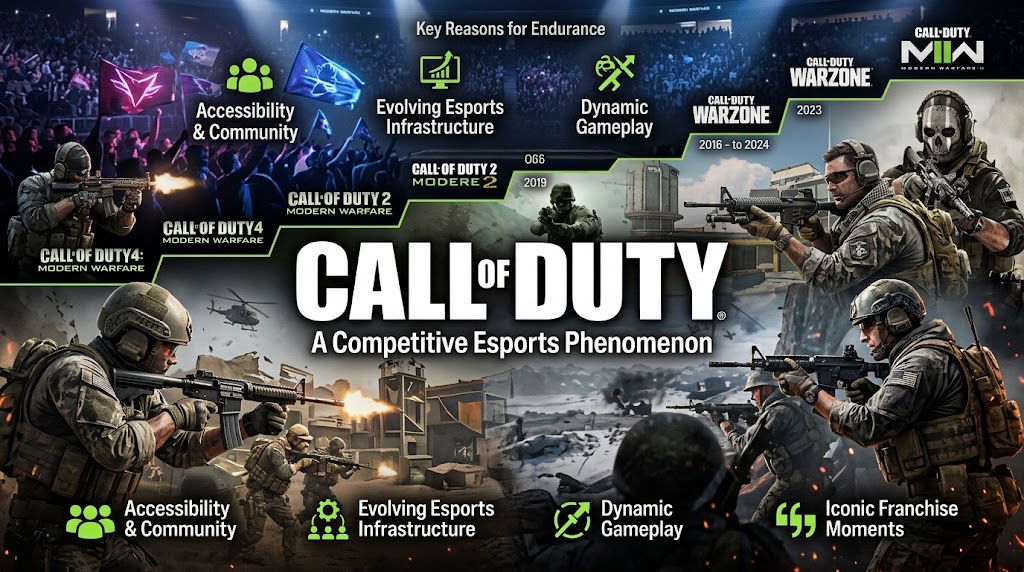
    Plenty of shooters have had a moment. Fewer have had two decades of them. Call of Duty’s competitive scene has survived console generations, engine overhauls, at least one genuinely disastrous game, and more format experiments than most franchises would risk trying once.

    That’s not just popularity carrying it — plenty of popular games never build a competitive scene that outlasts the hype cycle. Something about how the ecosystem was built made it durable in a way that’s worth actually picking apart.

    The Competitive Roots of Call of Duty

    The competitive instinct showed up almost immediately, and it didn’t come from the developers pushing it — it came from players who wanted a version of multiplayer with the randomness stripped out. LAN competition was the first real proving ground. No lag, no lobby drama, just whoever showed up with a rig and a mouse they trusted.

    Community tournaments followed the same pattern you’d see in Competitive Gaming in Asia — a handful of committed organizers, prize pools that started as glorified entry-fee pots, and word-of-mouth as the only marketing.

    Clan culture did a lot of the heavy lifting here. A tag in front of your name meant something. It signaled you belonged to a group that took the game seriously enough to practice together instead of just queuing solo, which is a small thing that mattered a lot more than it sounds.

    Why Its Core Mechanics Work for Competition

    Not every shooter translates to competitive play, and Call of Duty’s mechanics happen to hit a sweet spot most others miss. Time to kill is fast enough that decisions get made in fractions of a second, which rewards the kind of split-second reads that separate good players from great ones.

    Aim mechanics are demanding but learnable — there’s a visible skill ceiling, but it’s not so punishing that new players bounce off immediately.

    Movement adds another layer most people underrate. Strafing, sliding, positioning around corners — none of it works on its own, but combined with map knowledge it turns every engagement into a small tactical puzzle instead of a pure reflex test. Team coordination ties the rest together.

    A player with perfect aim and no communication loses to a squad that’s calling out enemy positions and rotating together. That balance between individual mechanical skill and team-level decision-making is honestly the whole reason the competitive multiplayer format scene works.

    The Importance of Map Design and Game Modes

    Objective-based modes did more for competitive Call of Duty than deathmatch ever could. Search and Destroy, Hardpoint, Control — these force map control to actually mean something instead of just being a byproduct of where kills happen to occur.

    Whoever holds the middle of the map usually dictates the pace of the round, and that’s a strategic layer deathmatch formats just don’t have.

    Team roles emerged out of necessity once objectives got involved. Someone anchors a site, someone flanks, someone holds information duty and calls rotations.

    None of this was written into a rulebook — it developed because objective-based modes punish teams that don’t divide responsibilities. Strategic decision-making stopped being optional at that point. You can’t out-aim your way through a well-set-up defense; you have to out-think it too.

    From Community Competition to Organized Esports

    Amateur tournaments were the training ground long before anything resembling a professional structure existed. Players cut their teeth in exactly the kind of grassroots events covered in Tournament Formats — single-elimination brackets, community-run, prize money that barely covered gas money for anyone who had to travel.

    Professional teams started forming once it became clear the same rosters kept winning regardless of which local scene they entered.

    Organized leagues formalized what had been ad hoc for years, and championships gave the whole thing a calendar and a season structure that amateur tournaments never had.

    That structure mattered more than people give it credit for — a season means players can actually plan around competing instead of hoping the next tournament happens to line up with their schedule.

    How Call of Duty Built a Spectator-Friendly Format

    Watching competitive Call of Duty doesn’t require the viewer to understand ten years of meta history of esports competition, and that’s a genuine advantage over some of its FPS peers. Fast action keeps engagement high even for someone who wandered in without context.

    Objectives are visually obvious — a bomb site, a hill to hold — so the stakes of any given moment read clearly even to a first-time viewer.

    Team battles compress into short, digestible rounds instead of sprawling matches that demand a huge time commitment. That’s a real structural advantage for a spectator sport.

    Short competitive moments mean highlight clips travel well on social media, which quietly does more for growing an audience than any marketing campaign the publisher runs.

    The Franchise’s Ability to Adapt

    New releases every year could have killed the competitive scene just as easily as they sustained it — annual iteration is a genuine risk when a community has to relearn a meta constantly.

    Instead, gameplay changes mostly got absorbed rather than resisted, partly because the underlying skills — aim, movement, map sense — carry over even when a specific title’s mechanics shift.

    New platforms and inevitably new consoles kept expanding who could actually play at a competitive level. Mobile expansion, through Call of Duty Mobile specifically, opened the door in regions where console and PC gaming were never realistic entry points to begin with — a pattern that echoes what happened with mobile titles more broadly in Competitive Gaming in Asia.

    Each of these shifts could have fragmented the community. Somehow the core competitive identity held together anyway.

    Why Competitive Communities Outlive Individual Games

    This is maybe the least obvious part of the whole story. Individual Call of Duty titles come and go, but the community around competitive play doesn’t reset with each release — it carries forward.

    Player familiarity with the broader systems, even across mechanical changes, means veterans don’t have to relearn the game from scratch every year the way a total newcomer would.

    Skill development compounds across titles in a way that’s easy to miss from outside the scene. Aim discipline and map-reading instincts built on one game transfer to the next almost intact.

    Community identity reinforces this further — the same organizations, the same rivalries, the same players people have followed for years, all of it persists even as the specific game underneath changes.

    That continuity is arguably what makes a multiplayer game competitive in the first place: not the mechanics alone, but a community that keeps showing up for them.

    Call of Duty’s Place in Competitive Gaming History

    Legacy is a word that gets thrown around too easily, but in this case it’s earned. Call of Duty helped normalize competitive console shooters at a time when PC titles dominated the conversation almost completely.

    Its influence shows up in how other franchises structure objective modes, build spectator formats, and think about balancing individual skill against team coordination.

    Its relationship with the broader FPS esports landscape is less about competing for attention and more about proving a specific model works — fast, accessible, spectator-friendly competition doesn’t need a steep learning curve to sustain a serious scene.

    Plenty of shooters have tried to replicate pieces of that formula since. Few have managed the whole package as consistently.

    Long-term competitive success needs more than popularity. It needs mechanics that reward depth without punishing newcomers, formats that hold up on a screen for people who’ve never played the game, and a community willing to carry its identity forward through a decade of sequels. Call of Duty has all three, which is a rarer combination than the franchise’s mainstream reputation usually gets credit for.

  • How Competitive Gaming in Asia Grew From Local Tournaments Into a Global Force

    How Competitive Gaming in Asia Grew From Local Tournaments Into a Global Force

    Ask someone who’s been around Asian esports since the early days how it started, and you’ll get a story about a specific cafe, not a movement. A room with decent PCs, a few regulars who kept showing up, someone eventually taping a bracket to the wall because enough people wanted to know who was actually good.

    That’s it. No sponsor, no broadcast deal, nobody thinking they were building anything. Just a rivalry that needed settling.

    South Korea’s the example everyone reaches for, and honestly it deserves it. PC bangs took off in the late 90s mostly because home internet was garbage almost everywhere at the time, and StarCraft turned into something closer to a national obsession than a hobby. I don’t think anyone planned that.

    Cheap, fast connections happened to exist in one specific place at one specific moment, and StarCraft happened to be the game everyone was playing when it did. Korea produced some of the first professional gamers on the planet mostly because of that accident — the game and the infrastructure lined up years before most of the world had either.

    The Early Days of Competitive Gaming in Asia

    LAN cafes solved two problems nobody was trying to solve on purpose. Cheap access to hardware players couldn’t buy themselves, and a room where you sat next to the person you were trying to beat.

    That second part gets underrated. Trash talk, rematches on the spot, glancing at someone’s screen mid-game — you learn faster sitting three feet from a rival than you do grinding solo at home, and everyone who was there will tell you the same thing.

    Communities built up around specific shops and specific games. Ask around Jakarta from that era, and someone will mention “the DOTA place” like it’s a landmark, because it kind of was.

    Tournament formats back then were held together with duct tape, basically. Entry fees pooled into a prize, a bracket stuck to a wall, maybe the cafe owner threw in something extra because a packed house on a Saturday was good for business either way.

    Nobody was building an industry. People just wanted bragging rights over the guy who picked the same character every single match.

    How Local Communities Created Competitive Scenes

    Teams didn’t form because someone drew up a plan. A few players kept ending up on the same side, or kept losing to the same rival duo, and eventually started practicing on purpose instead of by accident.

    That’s more or less the origin story for team culture across the region — Counter-Strike squads in the Philippines, early DOTA rosters in China, doesn’t matter where you look, it rhymes.

    The organizers were rarely businesspeople. Usually just the player who cared enough to actually run something. A flyer taped up at the cafe. A forum post. If you were lucky, a mention on local radio because the organizer’s cousin worked there.

    There was no ticketing, no stream, no way to watch unless you physically showed up. Which meant the audience and the competitors were often the same twenty people, just wearing different hats depending on the day.

    The Rise of Regional Tournaments

    City scenes started feeding national ones, and national scenes started eyeing each other across borders — though not on any kind of shared timeline.

    Korea’s StarCraft scene professionalized way ahead of most of Southeast Asia’s gaming market, partly because Korean broadcast TV picked up esports early. OGN was running dedicated matches on television when that idea would’ve sounded absurd almost anywhere else.

    Going cross-border introduced headaches local tournaments never had to deal with. Travel budgets. Visas. Arguments over whose house rules applied when two regions had drifted slightly on the same game.

    Prize pools grew, but slower than people like to remember — some early regional events paid out less than what it cost players to get there in the first place.

    Sponsorship eventually fixed that math, though unevenly. Some countries had telecoms and hardware brands willing to write checks years before their neighbors did.

    Internet Infrastructure Changed the Scale of Competition

    None of the regional stuff works without the internet actually catching up, and it’s easy to forget how recently that happened. Broadband rollout across East and Southeast Asia through the 2000s and into the 2010s meant you didn’t need a cafe anymore to play at a decent level — though a lot of people kept going anyway, because home connections in plenty of places still couldn’t touch what a cafe offered.

    Latency was brutal in ways that get glossed over now. A player in Manila queuing against someone in Seoul on early matchmaking wasn’t just playing the opponent; they were fighting the ping too.

    Server placement made this worse — publishers defaulted to North America and Europe for years, which left chunks of Asia with connection quality that didn’t match how many players were actually there. Regional servers eventually caught up, and once they did, online cross-border competition stopped being a novelty and started being normal.

    The Professionalization of Asian Esports

    Somewhere in between “team that scrims together” and “team on a payroll,” things shifted. Coaches started breaking down replays the way a football coach breaks down game film.

    Analysts tracked opponent tendencies instead of just vibing off memory. Sponsors moved on from the local phone shop to telecoms and energy drink brands with actual marketing departments behind them.

    Leagues locked this in. A season structure meant players could plan a career around competing instead of treating it as something you did between real jobs.

    Streaming did the rest. Once anyone with a connection could watch a match instead of only the twenty people in the room, sponsors finally had numbers they could point to — viewers, engagement, something resembling a return.

    Why Asia Became Central to Competitive Gaming

    Population helps, sure, but that’s the lazy explanation. Plenty of regions have big populations and never built anything close to this. What’s different is that gaming as a legitimate pursuit got accepted earlier and more openly in several Asian countries, while “professional gamer” was still a punchline at a lot of Western dinner tables well into the 2010s.

    Mobile mattered enormously in Southeast Asia specifically, and I’d argue more than people give it credit for. A gaming PC is expensive. A phone is something most people already own. Mobile Legends and PUBG Mobile built massive competitive scenes in the Philippines, Indonesia, and Vietnam largely because the barrier to entry was a device people already had in their pocket.

    Stack that on top of steadily improving internet and years of accumulated cafe-culture know-how, and you get a region that didn’t need to import competitive gaming from anywhere. It grew on its own and kept compounding.

    From Local Tournaments to a Global Audience

    Streaming did something local tournaments never could — it made a Manila crowd’s tournament watchable in São Paulo without anyone leaving their couch. Fifteen years ago, watching a foreign region meant hunting down a grainy upload weeks after the fact, assuming one existed at all.

    International events made the shift concrete. When Asian teams started actually winning — The International, League of Legends Worlds, Counter-Strike majors — it did two things at once.

    It proved the regional talent could hang with anyone on earth, and it forced Western audiences to stop treating Asian leagues as some separate, lesser tier worth a passing glance at best.

    What Comes Next for Competitive Gaming in Asia

    Mobile esports isn’t just keeping pace anymore; it’s arguably setting it, which is a real reversal from a decade ago when PC and console led, and mobile followed.

    Cross-platform play is muddying lines that used to be clean, and leagues are still arguing over fairness and matchmaking in ways that don’t have tidy answers yet.

    Cloud gaming could, in theory, remove hardware as a barrier entirely. In practice, the infrastructure to make that work well is still patchy across parts of the region, so I wouldn’t bet on it happening evenly or soon.

    New players keep arriving through mobile titles that ask for almost nothing upfront, which is probably the more reliable growth story here than cloud gaming for the next few years at least.

    None of this happened because of one tournament or one breakout star, whatever the highlight reels want you to believe. It came from cafes that gave players somewhere to compete, rivalries that hardened into teams, infrastructure that kept expanding what was actually possible online, and a slow professionalization process that turned casual competition into something people could build a career on.

    That’s a long, uneven history — and it’s why Asia isn’t just showing up to global esports anymore. Most of the time, it’s the one setting the pace.